Direct-to-Mobile (D2M) Technology in India: Live TV Without Internet on Mobile – Prasar Bharati Trials, Current Status and COAI Concerns
What is Direct-to-Mobile (D2M) technology?
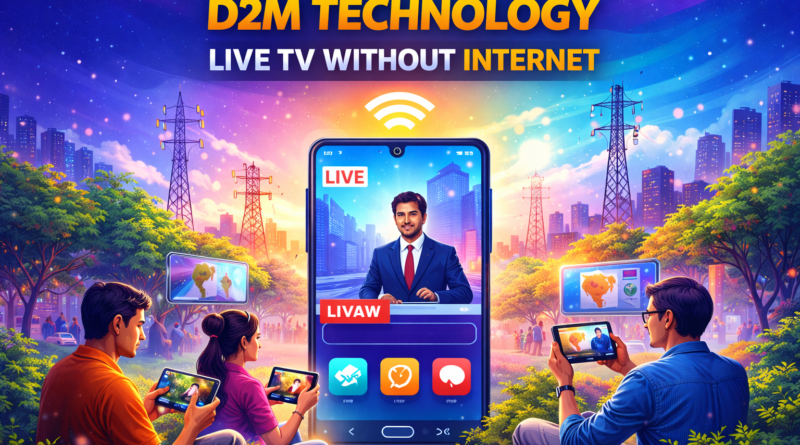
Direct-to-Mobile (D2M) is a broadcast-to-phone technology that sends TV/video, audio, text alerts, and even file/data services directly to a mobile device over broadcast spectrum, instead of streaming it over 4G/5G mobile data.
Think of it like this:
- Traditional streaming = unicast (every viewer gets a separate stream; networks get congested during big events).
- D2M = broadcast/multicast (one transmission serves millions at once, similar to TV broadcasting—just optimized for mobile devices).
In India’s context, D2M trials have been discussed around broadcast standards and “broadcast + broadband” convergence, where live content (or critical messages) can be delivered efficiently, and the internet can be used only when needed (interactive features, on-demand, personalization, etc.).
Why is India (Prasar Bharati) testing D2M?
Prasar Bharati (India’s public broadcaster) is testing D2M mainly to achieve 4 big goals:
1) Live TV on phones without consuming mobile data
If a cricket match or breaking news is watched by millions at the same time, telecom networks can get heavy load. D2M aims to deliver popular live channels to phones without adding load to 4G/5G unicast capacity, because it works like broadcasting.
2) Emergency alerts that work even when networks are jammed
During floods, earthquakes, or major incidents, cellular networks can get congested. A broadcast-based path can remain effective for:
- public warnings,
- evacuation instructions,
- critical updates (text/audio).
3) Faster, lower-cost reach to Tier-2/Tier-3 areas
Broadcast infrastructure can cover wide areas efficiently. That makes D2M attractive for bridging the “connectivity + content access” gap where mobile data quality may be inconsistent.
4) A new distribution layer for broadcasters
Broadcasters get an alternative way to reach audiences on mobile screens—potentially with new ad formats, interactive triggers, or bundled services.
Prasar Bharati has been working with ecosystem partners and trials have been discussed publicly over the last few years as India explores broadcast-broadband convergence.
How does D2M work (simple explanation)
While the engineering details can get deep, at a high level:
- Content is broadcast from high-power/low-power transmitters (similar to TV towers, but optimized for mobile reception).
- A compatible device (or accessory) receives it.
- The phone can display live content, and optionally combine it with broadband for interactive experiences.
One practical challenge is device support—phones need compatible chipsets/receivers (or external dongles/cases), which is why “device ecosystem readiness” is a big part of the trials.
Current status in India: where the project stands right now
As of early January 2026, the topic is in the spotlight again because telecom operators (through COAI) have objected to how the recent technical evaluation/trials were conducted and want a re-run with broader participation.
At the same time, multiple reports indicate Prasar Bharati-led work has progressed through pilots/technical evaluations and is moving toward rollout—though final approvals and a clear commercial framework are still key gating items.
When is D2M expected to launch in India?
Based on recent reporting, India’s D2M initiative is being positioned to move toward a rollout phase by mid-2026, with commercial services expected later (often described as toward end of 2026, subject to approvals and ecosystem readiness).
Important reality check:
D2M “launch” can mean different things—pilot expansion, limited city rollout, or full commercial services nationwide. The timeline will ultimately depend on:
- policy approvals (especially around spectrum use),
- coexistence/interference validation,
- device availability at scale,
- a business model that doesn’t break telecom economics or broadcast economics.
What COAI is saying (and why telecom operators are worried)
COAI (Cellular Operators Association of India) has raised serious concerns around the D2M testing/evaluation approach and its potential spectrum impact.
Here’s the core of their position, as reported:
1) “Not transparent / not consultative enough”
COAI says the tests were conducted without adequate involvement of telecom service providers and relevant stakeholders like device ecosystem players—so the process should be redone with participation.
2) Spectrum is the real battleground
Telecom operators argue D2M has direct implications for spectrum bands that may be needed for current/future 5G, and any new broadcast use must be evaluated carefully for long-term spectrum planning.
3) Coexistence / interference concerns must be proven beyond doubt
Even if some trial results suggest minimal interference, telcos want a technology-neutral, regulator-aligned evaluation under a framework they consider fair and repeatable.
COAI has also made formal representations to DoT in the past on what should be included in the technical evaluation ToR (terms of reference), indicating this has been a running policy/industry discussion rather than a sudden objection.
What Prasar Bharati (and supporters) want to demonstrate
From the way the project has been described publicly, Prasar Bharati and the D2M ecosystem are trying to prove:
- D2M can deliver live content at scale and reduce pressure on cellular networks during peak events.
- Coexistence risks (interference, device heating concerns, etc.) can be addressed through technical validation and standards-based deployment (this is part of what recent debate is about).
- India can build a viable device + transmitter ecosystem with local partners and practical consumer form factors.
What this could mean for everyday users (if it launches)
If D2M becomes commercially available and phones support it, users could see:
- Live TV channels on mobile without data usage
- Better experience during major live events (less buffering)
- Emergency alerts that still arrive when networks are overloaded
- Potentially lower cost “basic TV/info access” options for regions with weaker broadband
But the “if” is important: the commercial model, spectrum policy, and device compatibility will decide whether D2M becomes mainstream or stays niche.
Frequently Asked Questions (FAQ)
Q1. Is Direct-to-Mobile the same as watching TV on an app?
No. Apps stream content over mobile data (unicast). D2M broadcasts content directly to the phone without using cellular data.
Q2. Will D2M work on all smartphones?
Not automatically. Devices typically need compatible receiver/chipset support (or external accessories), which is why device ecosystem readiness is a key requirement.
Q3. When will D2M launch in India?
Recent reports indicate rollout could move by mid-2026, with commercial services later—subject to approvals, ecosystem readiness, and spectrum decisions
Q4. Why are telecom operators (COAI) objecting?
COAI has raised concerns about the transparency and stakeholder inclusion in trials, and warns that D2M could affect spectrum planning and coexistence with 5G.
Q5. Can D2M reduce 5G network congestion?
That’s one of the key promises: broadcast can offload popular live video that would otherwise consume large unicast capacity.