Understanding eSIM: What It Is, How It Works, Benefits, Risks, and the Future of SIM Cards
SIM cards have been an essential part of mobile communication for decades. From large plastic SIMs to micro and nano SIMs, we’ve seen them shrink in size—but now, a new technology called eSIM is changing how we connect to mobile networks.
But what exactly is eSIM? How is it different from a physical SIM card? Is it safe? And will eSIM completely replace physical SIMs in the future?
This blog answers everything you need to know about eSIM, including benefits, risks, supported phones, activation steps, and future outlook.
What Is eSIM?
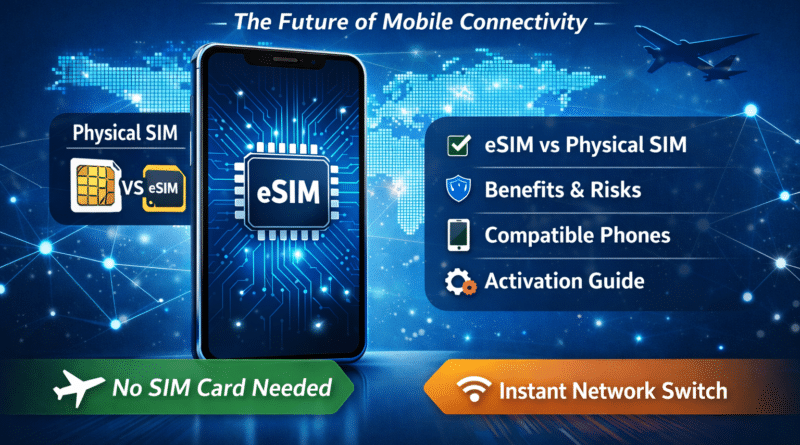
eSIM (Embedded SIM) is a digital SIM that is built directly into your smartphone, tablet, smartwatch, or laptop. Unlike a physical SIM card, it cannot be removed or replaced.
Instead of inserting a SIM card, users download a mobile network profile from their telecom operator by scanning a QR code or via an app.
Key Definition:
- eSIM = Embedded + Reprogrammable SIM
- No physical card required
- Network profiles can be added or removed digitally
eSIM vs Physical SIM: What’s the Difference?
| Feature | Physical SIM | eSIM |
|---|---|---|
| Form | Plastic card | Built into device |
| Replacement | Manual insertion/removal | Digital profile |
| Switching networks | Requires SIM change | Can be done digitally |
| Risk of damage | Can be lost or damaged | No physical damage |
| Device space | Occupies slot | Saves internal space |
4
Benefits of Using eSIM
1. No Physical SIM Required
No more tiny SIM cards, trays, or ejector pins.
2. Easy Network Switching
You can change telecom operators without visiting a store.
3. Dual SIM Without Two Slots
Many phones support physical SIM + eSIM, making dual SIM easier.
4. Ideal for Travelers
Add an international eSIM plan instantly without buying local SIMs.
5. Better Device Design
Manufacturers save space, helping with:
- Slimmer phones
- Larger batteries
- Improved water resistance
Risks & Limitations of eSIM
1. Phone Damage = SIM Loss
If your phone is damaged or lost, eSIM recovery may be difficult.
2. Limited Carrier Support
Not all telecom operators support eSIM in every country.
3. Device Dependency
Transferring eSIM to a new phone often requires carrier approval.
4. Not Ideal for Frequent Phone Swappers
Physical SIMs are still easier to move between devices.
Which Phones and Brands Support eSIM?
Smartphones Supporting eSIM
- Apple
- iPhone XS and later
- iPhone 14+ (US models are eSIM-only)
- Samsung
- Galaxy S20 and newer
- Galaxy Z Fold / Flip series
- Google
- Pixel 3 and later
- Xiaomi
- Xiaomi 12, 13 series (selected regions)
- Motorola
- Edge series, Razr series
Telecom Operators Supporting eSIM (India & Global)
India:
- Airtel
- Jio
- Vi
International:
- Vodafone
- AT&T
- T-Mobile
- Orange
- Airalo (Travel eSIM)
How to Activate eSIM – Step-by-Step Guide
General eSIM Activation Process
- Check device compatibility
- Request eSIM from your telecom operator
- Receive QR code via email/SMS
- Open Phone Settings
- Settings → Network / Mobile → Add eSIM
- Scan the QR Code
- Confirm & Activate
- Restart device if required
⏱ Activation usually takes 2–10 minutes.
Important Tips:
- Internet connection required
- QR code can be used only once
- Do not reset phone before activation completes
Is eSIM Safe and Secure?
Yes, eSIM is considered more secure than physical SIMs because:
- Cannot be physically stolen
- Encrypted network profiles
- Harder to clone
However, account security still depends on:
- Strong passwords
- SIM lock / carrier verification
- Device security (PIN, biometrics)
Will eSIM Completely Replace Physical SIMs?
Short Answer: Not Yet
Likely Future Scenario:
- Premium phones → eSIM-only
- Budget phones → Physical SIM continues
- IoT devices → eSIM dominance
- Travel & wearables → eSIM standard
Physical SIMs may remain relevant for:
- Rural markets
- Feature phones
- Easy SIM swapping
Final Verdict: Should You Use eSIM?
Use eSIM If:
✔ You travel frequently
✔ You want dual SIM convenience
✔ You use premium smartphones
✔ You prefer digital setup
Stick to Physical SIM If:
❌ You frequently change phones
❌ You live in areas with limited carrier support
❌ You prefer offline SIM replacement
Conclusion
eSIM represents the future of mobile connectivity, offering flexibility, convenience, and modern device design. While it may not completely eliminate physical SIMs immediately, adoption is growing rapidly.
As telecom infrastructure improves, eSIM will become the default, especially for smartphones, wearables, and connected devices.