Importance of DSPM and CSPM Solutions: Benefits, Risks & Top Vendors
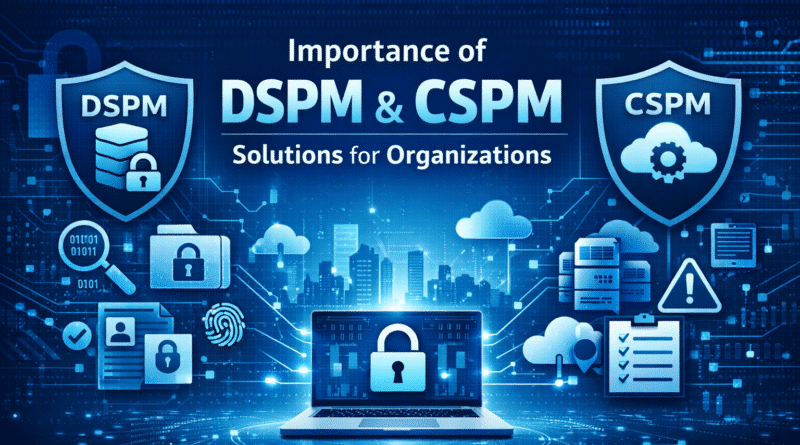
Data Security Posture Management (DSPM) and Cloud Security Posture Management (CSPM) are complementary security disciplines that together help organisations find, prioritize, and fix risky data exposures and cloud misconfigurations. DSPM focuses on what the sensitive data is and who can access it, while CSPM focuses on how cloud infrastructure and configurations introduce risks. Implementing both gives security teams visibility across data, identities, cloud resources, and compliance posture — turning guesswork into measurable security controls.
What are DSPM and CSPM?
- DSPM (Data Security Posture Management): Discovers, classifies, maps, and monitors sensitive data across cloud, SaaS, databases, and on-prem repositories to identify exposure, over-permissioning, and compliance gaps.
- CSPM (Cloud Security Posture Management): Continuously checks cloud accounts, IaC templates, and runtime resources for misconfigurations, compliance violations, insecure network rules, and risky identity settings.
Difference between DSPM and CSPM Solution
- Primary focus: DSPM = data (discovery, classification, exposure). CSPM = cloud resources & configs (IAM, network, storage settings).
- Core outputs: DSPM → sensitive data inventory, exposure scoring, data-centric risk maps. CSPM → configuration alerts, compliance posture scores, IaC scanning.
- How they work together: CSPM spots a misconfigured S3 bucket; DSPM reveals whether that bucket contains regulated PII and who can access it — together they produce prioritized, actionable risk to fix first.
Why IT leaders must care: business & security impact
- Prioritized risk reduction: DSPM + CSPM turn millions of alerts into high-value remediation tasks by linking data sensitivity to cloud misconfiguration — letting teams fix what matters first.
- Faster incident response: With data maps and configuration context, security teams can quickly scope breaches, reduce dwell time, and meet forensic/regulatory needs.
- Compliance readiness: Automates evidence collection and continuous checks for standards such as GDPR, PCI-DSS, HIPAA, and regional data rules.
- Secure cloud adoption: Enables DevOps and cloud teams to move faster while keeping guardrails enforced via IaC scanning and data-aware checks.
- Cost avoidance: Prevents fines, customer churn, and expensive breach recoveries by proactively finding exposures.
Benefits of DSPM and CSPM solution
- Unified visibility across data & cloud assets
- Actionable, prioritized remediation (reduce alert fatigue)
- Continuous compliance and audit trail generation
- Reduced blast radius from misconfigurations and insider mistakes
- Better alignment between security, cloud engineering, and compliance teams
Risks of not having DSPM and CSPM
- Blind spots: Unknown sensitive data in unmanaged SaaS or shadow IT.
- High-impact misconfigurations: Public cloud resources exposing data without knowing what’s at risk.
- Slow, expensive breach response: Missing data maps delays containment and notification.
- Regulatory fines & reputational damage: Inability to prove compliance or find exposed regulated data.
- Developer friction: Without automated posture checks, speed of cloud delivery increases risk vectors.
How these solutions help IT leaders strengthen security (practical use cases)
- CISO / Head of Security: Prioritize remediation budgets based on business-critical data exposure and regulator risk.
- Security Operations (SecOps): Reduce mean time to detect & remediate by correlating data exposure with cloud misconfigs.
- Cloud / Platform Teams: Shift-left posture checks into CI/CD (IaC scanning) to prevent insecure deployments.
- Compliance / Risk Teams: Produce continuous evidence and alerts mapped to frameworks and policies.
- Business Units: Protect customer trust by ensuring sensitive product data and PII are never accidentally exposed.
Best OEMs / top vendors for DSPM and CSPM
Below are well-recognized vendors (DSPM and/or CSPM/CNAPP capabilities). Pick based on cloud footprint, integrations, and whether you want a single vendor or best-of-breed mix:
- Palo Alto Networks — Prisma Cloud (CNAPP) offers CSPM plus data visibility and DSPM integrations.
- Microsoft — Microsoft Purview / Defender for Cloud provide DSPM-style data discovery plus native CSPM for Azure (and multi-cloud support).
- Wiz — CNAPP leader that provides broad CSPM, risk context, and partner integrations for data mapping.
- Orca Security — Agentless cloud security platform with strong CSPM and asset-level context that pairs well with DSPM tools.
- Cyera — DSPM-focused provider that excels at data discovery and exposure prioritization.
- BigID — DSPM and data governance leader for data discovery, classification, and privacy use cases.
- Lacework — CSPM & CNAPP capabilities with runtime and IaC scanning.
- Sentra — Emerging DSPM vendor noted in market roundups for data-centric posture management.
- Aurva – Provide a complete Data Security Platform, which includes DSPM, Data Flow Analysis and Database Activity Monitoring Solution.
Check Complete detail on Aurva Data Security Platform, How it integrates DSPM and DAM Solution.
Single vendor for DSPM + CSPM? Look for CNAPP/CSPM platforms that either include DSPM modules or integrate tightly with DSPM partners (for example, platforms like Palo Alto Networks and Microsoft have broad portfolios). For best-of-breed approach, pair a dedicated DSPM (e.g., Cyera or BigID) with a CNAPP/CSPM (e.g., Wiz or Orca Security).
Note: Choose vendors based on cloud platforms used (AWS/Azure/GCP), data types (structured vs unstructured), required compliance frameworks, and team maturity.
Quick buyer checklist
- Do you have an accurate inventory of sensitive data across cloud, SaaS, and on-prem? → If no, you need DSPM.
- Do you have continuous checks for IAM, network, and storage misconfigurations? → If no, you need CSPM.
- Want one console? Evaluate CNAPPs with DSPM modules or tight partner integrations.
- Prioritize vendor proof-of-concepts (PoCs) against real, high-risk datasets and IaC templates.
- Ensure the vendor supports automation (tickets, remediation, DevOps integrations) and reporting for auditors.
FAQ
What is the difference between DSPM and CSPM?
DSPM focuses on discovering and protecting sensitive data; CSPM focuses on cloud configuration and infrastructure posture.
Do I need both DSPM and CSPM?
Yes — together they provide data-and-infrastructure context needed to prioritize fixes and reduce real business risk.
Can a single vendor provide both DSPM and CSPM?
Some CNAPP platforms offer both or integrate DSPM modules; many organisations prefer best-of-breed combos depending on cloud and data needs.
What are risks of not having DSPM/CSPM?
Blind spots on sensitive data, costly breaches, regulatory fines, and slow incident response.
Final Thought
For IT leaders: start with discovery. Run a DSPM scan on a high-value dataset (finance, customer PII) and a CSPM scan on high-privilege cloud accounts. Use the insights to run a 90-day remediation blitz: reduce over-permissioning, lock down public buckets, and codify IaC checks into CI. Need a tailored vendor shortlist or a 30-day POC plan for your environment? I can draft one based on your cloud footprint and compliance needs.