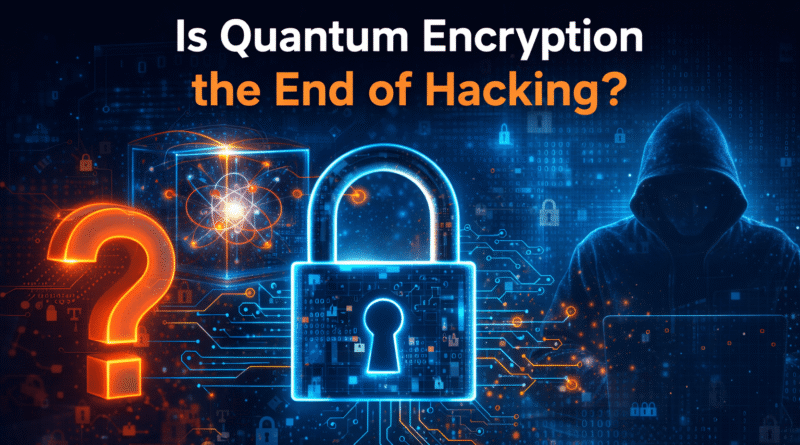
Quantum Encryption: End of Hacking or New Era?
As quantum computing moves closer to real-world deployment, cybersecurity experts worldwide are asking a critical question: Will today’s encryption survive the quantum revolution?
For decades, digital security has relied on mathematical complexity to protect sensitive data — from banking transactions and government communications to cloud storage and personal messaging. But emerging quantum computers may soon possess the power to crack many traditional encryption systems in minutes.
In response, researchers and technology leaders are turning toward Quantum Encryption technologies and Post-Quantum Cryptography (PQC) — two powerful approaches designed to secure the digital world against future quantum threats.
The stakes are enormous. Whoever wins the race to quantum-safe security could define the future of global data protection.
🔐 What Makes Quantum Encryption Different?
Quantum encryption is not just stronger encryption — it is an entirely different security model.
Instead of relying on mathematical difficulty, quantum encryption uses the laws of quantum physics to protect information. At the heart of this technology is a simple but profound scientific fact:
👉 Observing a quantum particle changes its state.
This means if someone attempts to intercept quantum-secured communication, the act of spying itself becomes instantly detectable.
The most widely implemented system is Quantum Key Distribution (QKD) — a method that transmits encryption keys using individual photons. If an attacker tries to measure or copy these photons, the disturbance alerts both sender and receiver immediately.
Security is no longer based on “making encryption hard to break.”
It is based on making undetected interception physically impossible.
🧮 The Algorithms Behind Quantum Encryption
Quantum encryption operates through specialized quantum communication protocols, often described as the foundational algorithms of quantum cryptography.
BB84 Protocol
Developed in 1984, BB84 uses photon polarization states to transmit secure keys. Any measurement mismatch reveals eavesdropping.
E91 Protocol
Based on quantum entanglement, where paired particles remain correlated across distance. Disrupting entanglement signals intrusion.
B92 Protocol
A simplified version of BB84 using fewer quantum states for efficient implementation.
Continuous Variable QKD
Uses properties like amplitude and phase of light instead of discrete photon states, enabling compatibility with telecom infrastructure.
These protocols form the backbone of modern quantum communication networks.
🌍 Where Quantum Encryption Is Already Being Used
Quantum encryption is no longer theoretical. Several countries and industries are actively deploying it.
- National defense and intelligence communications
- Financial transaction networks
- Secure government data links
- Satellite-based quantum communication systems
- Critical infrastructure protection
China, Europe, and the United States are investing heavily in quantum-secure communication infrastructure, including satellite quantum networks and fiber-based quantum internet projects.
⚠ But Quantum Encryption Isn’t the Only Solution
While quantum encryption secures communication channels, much of today’s digital world depends on software-based encryption — from websites to mobile apps to cloud storage.
That’s where Post-Quantum Cryptography (PQC) enters the picture.
🔐 Post-Quantum Cryptography: Security Without Quantum Hardware
Post-Quantum Cryptography focuses on creating new mathematical algorithms that even quantum computers cannot easily break.
Unlike quantum encryption, PQC does not require specialized hardware. It runs on existing computers and networks, making it easier to deploy at scale.
PQC algorithms are designed to resist attacks from quantum computers running powerful methods like Shor’s Algorithm, which could break current encryption systems such as RSA and Elliptic Curve Cryptography.
Major PQC approaches include:
- Lattice-based cryptography
- Hash-based signatures
- Code-based encryption
- Multivariate polynomial systems
Global standards bodies are already approving these algorithms for widespread adoption.
⚔️ Two Technologies, One Goal
Quantum encryption and PQC are not competing technologies — they solve different problems.
Quantum encryption protects communication channels using physics.
Post-Quantum Cryptography protects digital systems using quantum-resistant mathematics.
Cybersecurity experts increasingly agree that the future will rely on both together.
🚀 Why the Quantum Security Race Matters Now
Even though large-scale quantum computers are still developing, experts warn that waiting could be risky.
Cybercriminals can already store encrypted data today and decrypt it later once quantum computing becomes powerful enough — a threat known as “harvest now, decrypt later.”
This is why governments, banks, and technology companies are rushing to implement quantum-safe security before the quantum era fully arrives.
The transition is not optional — it is inevitable.
🧭 The Bigger Picture: A Quantum-Secure Internet
Researchers envision a future where:
✔ Quantum encryption protects communication networks
✔ PQC secures software and digital infrastructure
✔ Hybrid systems provide layered defense
✔ Global data flows remain secure even against quantum attacks
This would create the world’s first quantum-secure internet — a communication ecosystem where data remains protected at every stage of its lifecycle.
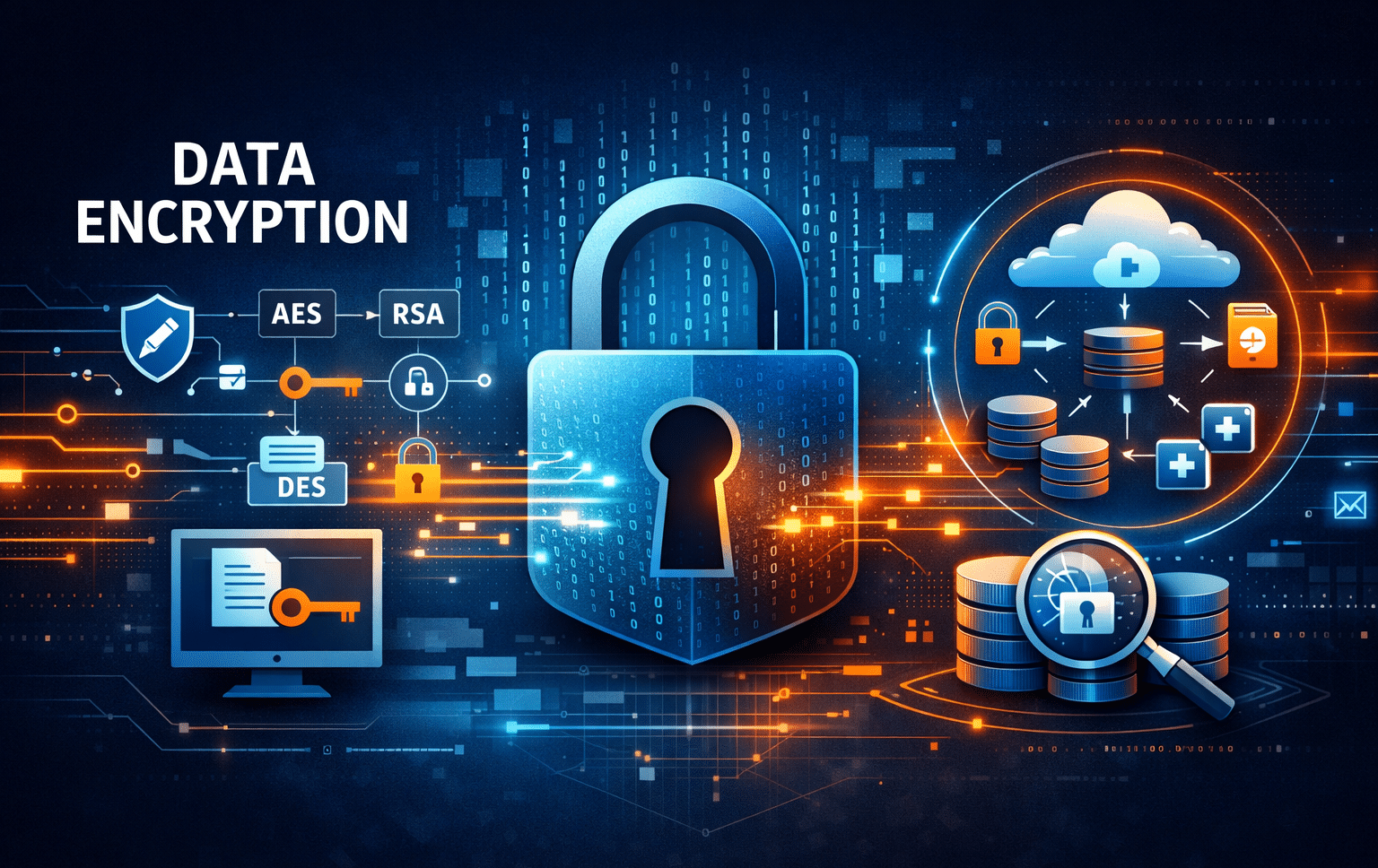
Also Read – Data Encryption Techniques Explained – Purpose, Algorithms & Homomorphic Encryption
❓ Frequently Asked Questions (FAQ)
-
What exactly is quantum encryption in simple terms?
Quantum encryption is a way of securing communication using the laws of quantum physics instead of traditional mathematical formulas. It typically works by sending encryption keys using individual particles of light (photons). Because quantum particles change when observed, any attempt to intercept or measure them is immediately detected. This makes it fundamentally different from traditional encryption, which can be broken if enough computing power is available.
-
Is quantum encryption truly unbreakable?
In theory, yes — quantum encryption is considered information-theoretically secure, meaning its protection does not depend on computational difficulty but on physical laws. An attacker cannot intercept quantum communication without disturbing the quantum state, which reveals their presence. However, in real-world deployments, security can still depend on hardware quality, implementation accuracy, and system design. So while the principle is unbreakable, practical systems must still be engineered carefully.
-
How is quantum encryption different from traditional encryption?
Traditional encryption methods (like RSA or AES) rely on complex mathematical problems that are hard for computers to solve. Quantum encryption does not rely on mathematical difficulty at all — it uses physical properties of quantum particles.
Traditional encryption tries to make hacking extremely difficult.
Quantum encryption makes undetected hacking physically impossible. -
What is Quantum Key Distribution (QKD) and why is it important?
Quantum Key Distribution is the most widely used method of quantum encryption. It allows two parties to securely share an encryption key using quantum particles. Once the key is safely exchanged, it can be used to encrypt data through conventional methods. QKD is important because the security of encrypted communication depends heavily on how safely the key is shared — and QKD provides the most secure key exchange method known today.
-
Which is better — Quantum Encryption or Post-Quantum Cryptography?
Neither is “better” overall — they serve different purposes.
Quantum encryption is ideal for securing communication channels with maximum physical security.
Post-Quantum Cryptography is more practical for large-scale deployment across websites, applications, and digital infrastructure.
Most experts believe the future will combine both technologies for layered protection.
🧾 Final Thoughts
Quantum encryption once sounded like science fiction — but today, it is rapidly becoming a strategic necessity. Combined with Post-Quantum Cryptography, it represents humanity’s most advanced attempt yet to secure information in an age of unprecedented computing power.
The real question is no longer whether quantum-safe security will arrive —
but who will be ready when it does.