
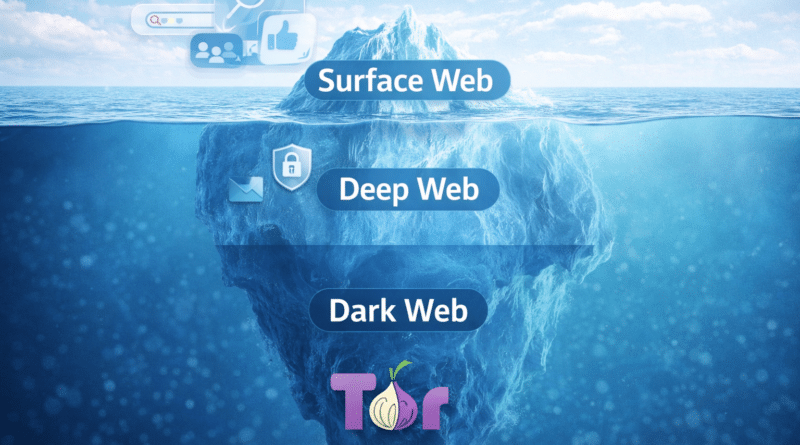
Surface Web, Deep Web & Dark Web Explained: What Lies Beneath the Internet You Use Every Day?
When we casually say “the internet”, we usually mean Google searches, news websites, YouTube, social media, and online shopping. But that familiar part is only the tip of the iceberg.
Beneath it lies a much larger, mostly invisible world—the Deep Web and the Dark Web. These terms are often used interchangeably, usually with fear or suspicion attached. In reality, they serve very different purposes, and most of us interact with them more often than we realize.
So what exactly are these layers of the web, how are they different, and why do they even exist?
Let’s break it down in a simple, human way.
🌐 The Surface Web: The Internet We All Know
The Surface Web is the publicly accessible part of the internet that search engines can index.
If you can find something through a Google search without logging in, it belongs to the surface web.
Common examples include:
- News websites and blogs
- Wikipedia pages
- Public forums and social media posts
- Company websites and landing pages
Despite feeling vast, the surface web is actually very small—estimated to be less than 10% of the total internet.
Its role is simple:
👉 Information meant for public consumption.
🔐 The Deep Web: Where Real Life Happens Online
The Deep Web is not hidden or illegal—it’s simply content that search engines can’t index.
In fact, most of your online life exists here.
What belongs to the Deep Web?
- Email inboxes
- Online banking and UPI portals
- Company dashboards and intranets
- Cloud storage (Google Drive, OneDrive)
- Medical records and insurance portals
- Private social media accounts
If something requires a username, password, OTP, or authentication, it automatically becomes part of the deep web.
Why the Deep Web Is Important
- Protects personal and financial data
- Ensures privacy and confidentiality
- Prevents unauthorized access
In short, the deep web exists for security, not secrecy.
You already access it daily—every time you check your email or bank balance.
🌑 The Dark Web: Hidden, Anonymous, and Often Misunderstood
The Dark Web is a small portion of the deep web, intentionally hidden and designed to provide strong anonymity.
It cannot be accessed through normal browsers like Chrome or Edge. Instead, it requires special tools such as the Tor Browser, developed by the Tor Project.
What makes the Dark Web different?
- Websites use
.onionaddresses - User identity and location are masked
- Traffic is routed through multiple encrypted nodes
- Both users and website owners remain anonymous
This design makes tracing activity extremely difficult.
⚖️ Why Does the Dark Web Exist at All?
Contrary to popular belief, the dark web wasn’t created for criminals.
Its original purpose was to:
- Protect free speech
- Enable anonymous communication
- Bypass censorship and surveillance
Legitimate use cases include:
- Journalists communicating with sources
- Whistleblowers sharing sensitive information
- Activists in restrictive countries
- Citizens avoiding mass surveillance
Several global media houses and human rights organizations even maintain dark web portals for secure submissions.
🚨 Then Why Is the Dark Web So Infamous?
Because anonymity can be misused.
The same protection that helps activists also attracts:
- Cybercriminals
- Drug marketplaces
- Stolen data sellers
- Scam and fraud networks
This is why the dark web frequently appears in cybercrime investigations and media headlines. It’s not entirely illegal—but it’s high-risk and unregulated.
🔑 How Do You Access Different Parts of the Web?
🌐 Surface Web
- Any browser (Chrome, Firefox, Edge)
- No login required
- Fully searchable
🔐 Deep Web
- Same browsers
- Requires credentials
- Examples: email, bank, work portals
🌑 Dark Web
- Tor Browser required
- Special
.onionURLs - Strong caution and awareness needed
⚠️ Accessing the dark web itself is legal in many countries, but what you do there matters.
📂 What Kind of Information Exists Where?
- Surface Web: News, blogs, public data, marketing content
- Deep Web: Personal, financial, corporate, and medical information
- Dark Web: Anonymous forums, whistleblowing platforms, illicit and legitimate services
Each layer serves a purpose—it’s the intent of usage that defines its impact.
🧾 Real-Life Examples That Make It Clear
- Deep Web: A hospital system storing patient health records
- Surface Web: A government website publishing public policies
- Dark Web (legitimate): A journalist receiving leaked documents securely
- Dark Web (illegal): Sale of stolen email-password databases after a breach
⚠️ Impact: Why Understanding These Webs Matters
Positive Impact
- Privacy protection
- Secure communication
- Freedom of expression
- Protection from surveillance
Negative Impact
- Cybercrime enablement
- Data leaks and fraud
- Law enforcement challenges
The internet, like any tool, reflects human behavior—not morality on its own.
🧠 Final Thoughts
The internet is not just what you see on Google.
- The Surface Web is public and searchable
- The Deep Web is private and essential
- The Dark Web is powerful, protective, and risky
Understanding these layers helps you stay informed, cautious, and digitally aware—without fear or misinformation.