Identity and Access Management (IAM): Why It Matters
In today’s digital-first world, organizations manage hundreds or even thousands of user identities across applications, networks, cloud platforms, and devices. Employees, partners, vendors, and customers all need access to systems to perform their tasks. However, controlling who can access what has become a major cybersecurity challenge.
This is where Identity and Access Management (IAM) comes into play. IAM is a critical cybersecurity framework that ensures the right individuals have the right access to the right resources at the right time.
With cyber threats increasing and regulations becoming stricter, IAM solutions have become a foundational part of enterprise security architecture. From preventing unauthorized access to protecting sensitive data, IAM helps organizations maintain both security and compliance.
What is Identity and Access Management (IAM)?
Identity and Access Management (IAM) is a security framework of policies, technologies, and processes that manage digital identities and control user access to organizational resources.
IAM solutions authenticate users and determine whether they should be allowed to access specific systems, applications, or data.
In simple terms:
- Identity → Who the user is
- Authentication → Verifying the user’s identity
- Authorization → Determining what the user can access
For example, in an organization:
- A finance employee should access accounting software
- A developer should access development servers
- A guest user should have limited access
IAM ensures that each user only receives the permissions necessary for their role.
Why IAM is Important for Modern Organizations
Identity has become the new security perimeter. Traditional security models relied heavily on firewalls and network security. However, with the rise of cloud computing, remote work, SaaS applications, and mobile devices, identities are now the primary gateway to enterprise systems.
1. Prevents Unauthorized Access
IAM prevents attackers from accessing systems by ensuring strong authentication mechanisms such as:
- Multi-Factor Authentication (MFA)
- Biometrics
- Smart cards
- One-Time Passwords (OTP)
Even if a password is compromised, MFA adds an additional layer of protection.
2. Protects Sensitive Data
Organizations handle sensitive information such as:
- Financial records
- Customer data
- Intellectual property
- Healthcare records
IAM ensures that only authorized users can access such data.
3. Supports Regulatory Compliance
Many regulations require strict access control and identity management, including:
- GDPR
- HIPAA
- PCI-DSS
- ISO 27001
IAM solutions help organizations meet these compliance requirements.
4. Enables Secure Remote Work
With remote and hybrid work models becoming common, employees need secure access from different locations and devices. IAM ensures secure authentication regardless of where users are accessing systems from.
5. Improves Operational Efficiency
IAM solutions automate identity lifecycle processes such as:
- User onboarding
- Role changes
- Access provisioning
- User offboarding
This reduces manual workload for IT teams.
What Security Risks Does IAM Protect Against?
IAM plays a critical role in protecting organizations from multiple cybersecurity threats.
1. Credential Theft
Attackers often steal passwords using phishing or malware. IAM mitigates this risk through Multi-Factor Authentication and adaptive authentication.
2. Insider Threats
Not all threats come from outside. Employees or contractors may misuse access privileges. IAM enforces least privilege access, ensuring users only have the permissions they need.
3. Privilege Escalation
Attackers sometimes gain low-level access and attempt to escalate privileges to gain administrative rights. IAM solutions monitor and restrict privilege escalation.
4. Unauthorized Data Access
IAM prevents unauthorized access to sensitive files, applications, and databases by enforcing strict authorization policies.
5. Account Takeover Attacks
Through behavioral analytics and anomaly detection, modern IAM solutions can detect suspicious login activity and block potential account takeovers.
Who or What Does IAM Protect Systems From?
IAM protects organizations from several types of threat actors.
External Cybercriminals
Hackers attempt to break into systems using stolen credentials, brute force attacks, or phishing campaigns.
Malicious Insiders
Employees with malicious intent may misuse their access to steal or manipulate sensitive data.
Negligent Users
Sometimes users accidentally expose credentials or share passwords. IAM enforces policies that reduce such risks.
Automated Bots and Credential Stuffing
Automated tools attempt to access systems using leaked credentials. IAM solutions can detect and block these attempts.
Key Components of Identity and Access Management (IAM)
IAM solutions consist of several components that work together to secure identities and access.
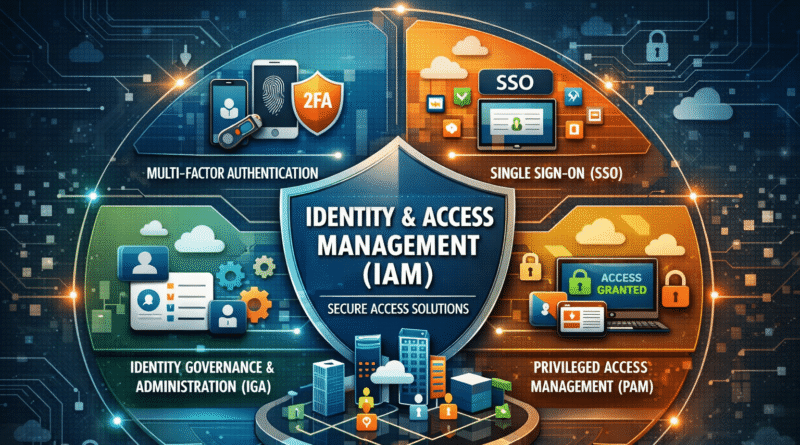
1. Identity Governance and Administration (IGA)
IGA manages the identity lifecycle and access governance within an organization.
Key functions include:
- User provisioning and deprovisioning
- Role management
- Access reviews and certification
- Compliance reporting
IGA ensures that users only have the appropriate access based on their roles.
2. Authentication
Authentication verifies a user’s identity before granting access.
Common authentication methods include:
- Password-based authentication
- Multi-Factor Authentication (MFA)
- Biometric authentication
- Smart cards
- Hardware tokens
Modern IAM systems also support adaptive authentication, which adjusts security requirements based on user behavior and risk level.
3. Authorization and Access Control
Authorization determines what resources a user can access after authentication.
Common access control models include:
- Role-Based Access Control (RBAC) – access based on job roles
- Attribute-Based Access Control (ABAC) – access based on attributes such as location, device, or department
- Policy-Based Access Control
This ensures users cannot access systems outside their responsibilities.
4. Single Sign-On (SSO)
Single Sign-On allows users to access multiple applications using one login session.
Benefits include:
- Improved user experience
- Reduced password fatigue
- Better security control
SSO is widely used for accessing SaaS applications and cloud platforms.
5. Privileged Access Management (PAM)
Privileged accounts have elevated permissions, such as system administrators or database admins.
PAM solutions help secure these accounts by:
- Monitoring privileged sessions
- Enforcing credential vaulting
- Limiting privileged access
- Recording administrator activities
6. Identity Federation
Identity federation enables secure identity sharing between organizations or systems.
It allows users to access external systems using their existing credentials.
Common federation protocols include:
- SAML
- OAuth
- OpenID Connect
This is widely used in cloud and SaaS environments.
7. Access Monitoring and Analytics
Modern IAM platforms use behavioral analytics and AI-driven monitoring to detect anomalies such as:
- Unusual login locations
- Suspicious login times
- Abnormal user behavior
These capabilities help detect insider threats and account compromise early.
IAM in the Era of Zero Trust Security
IAM is a key component of Zero Trust architecture, which follows the principle of:
“Never trust, always verify.”
Instead of assuming users inside the network are trustworthy, Zero Trust continuously verifies identities and device posture before granting access.
IAM enables this by enforcing:
- Strong authentication
- Continuous monitoring
- Context-aware access controls
Conclusion
Identity and Access Management (IAM) has become a cornerstone of modern cybersecurity strategies. As organizations adopt cloud services, remote work, and digital transformation initiatives, managing identities securely is more critical than ever.
IAM solutions ensure that the right people have the right level of access at the right time, helping organizations protect sensitive data, reduce security risks, and maintain regulatory compliance.
By implementing strong IAM frameworks with features such as MFA, SSO, PAM, and identity governance, businesses can significantly strengthen their security posture and protect their digital assets from evolving cyber threats.