5G Network Slicing: How Telecom Operators Build Custom Networks
As the world moves deeper into the era of 5G technology, telecom operators are introducing one of its most powerful and talked-about capabilities: 5G Network Slicing.
This advanced feature is changing how mobile networks operate by allowing telecom providers to create multiple virtual networks on a single physical 5G infrastructure. In simple words, one network can now behave like many separate networks—each optimized for different needs.
From smart factories and autonomous vehicles to gaming and premium mobile broadband, network slicing is becoming a major part of the future of connectivity.
What Is 5G Network Slicing?
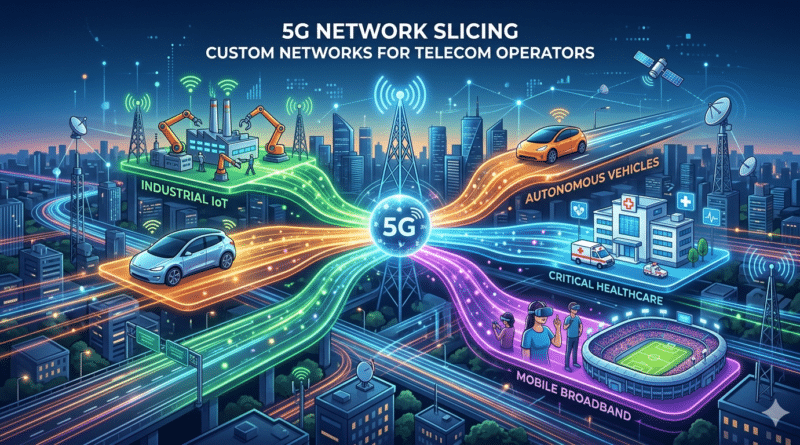
5G Network Slicing is a technology that divides a single physical 5G network into multiple independent virtual networks, called “slices.” Each slice can be customized with its own speed, latency, security, and performance levels.
Think of it like a highway with dedicated lanes:
- One lane for emergency vehicles
- One lane for trucks
- One lane for private cars
- One lane for VIP traffic
All lanes use the same road, but each serves a different purpose.
Similarly, telecom companies can create slices for healthcare, enterprises, gaming, smart cities, or everyday mobile users.
How Does 5G Network Slicing Work?
Network slicing is powered by several modern technologies:
1. Software Defined Networking (SDN)
Software-defined networking separates network control from hardware, making networks programmable.
2. Network Function Virtualization (NFV)
Network function virtualization converts traditional hardware-based network functions into software-based services.
3. Cloud Native 5G Core
A cloud-based 5G Core enables dynamic creation and management of slices.
4. AI and Automation
Operators use AI tools to monitor traffic and automatically optimize slice performance.
Why Is 5G Network Slicing Important?
Traditional mobile networks offer one-size-fits-all connectivity. But modern applications have very different requirements.
For example:
| Use Case | Need |
|---|---|
| Online Gaming | Low latency |
| HD Video Streaming | High bandwidth |
| Banking Apps | High security |
| Smart Factory | Ultra reliability |
| Autonomous Cars | Real-time response |
5G network slicing solves this problem by creating custom networks for each use case.
Which Telecom Operators Are Using Network Slicing?
Many leading operators globally have started deploying or testing 5G slicing.
Global Telecom Leaders
- Verizon
- AT&T
- T-Mobile US
- Vodafone
- Deutsche Telekom
- Telefonica
- China Mobile
- NTT Docomo
- SK Telecom
In India
Indian operators are actively exploring slicing for enterprise and industrial 5G services:
- Reliance Jio
- Bharti Airtel
- Vodafone Idea
As India expands private 5G and enterprise deployments, slicing is expected to become a major offering.
Is Network Slicing Only for Enterprises?
No. While enterprises are the first major users, network slicing can also benefit retail customers.
For Enterprise Customers
Enterprises may use dedicated slices for:
- Smart manufacturing
- Warehousing automation
- Remote healthcare
- Logistics tracking
- Oil & gas monitoring
- Banking secure connectivity
- Campus private 5G networks
For Retail Consumers
Consumers may also benefit through:
- Premium gaming slices
- Ultra-HD video streaming packages
- Low-latency AR/VR services
- Priority network access during congestion
- Smart home IoT packages
So yes, slicing is not limited to businesses.
Real-World Examples of 5G Network Slicing
Smart Factory
A manufacturer gets a private low-latency slice connecting robots and sensors.
Stadium Event
During a live match, operators create a temporary slice for broadcasters and security teams.
Emergency Services
Police and ambulance teams receive priority dedicated connectivity.
Gaming Users
A premium gamer package can get lower latency than regular traffic.
Benefits of 5G Network Slicing
1. Better Performance
Each service gets optimized bandwidth and latency.
2. Higher Security
Sensitive users can get isolated network environments.
3. New Revenue for Telecom Operators
Operators can sell premium connectivity packages.
4. Efficient Network Utilization
One infrastructure serves many needs.
5. Faster Innovation
Operators can launch new services quickly.
Challenges and Cons of Network Slicing
1. Complex Deployment
Requires advanced 5G core, automation, orchestration.
2. High Initial Cost
Cloud-native upgrades and software platforms cost money.
3. Security Management
If poorly configured, slices may face vulnerabilities.
4. SLA Enforcement
Operators must guarantee promised performance.
5. Device Compatibility
Some services need compatible devices and applications.
Is Network Slicing the Future of Telecom?
Industry experts believe yes.
As telecom companies shift from simple connectivity providers to digital service platforms, slicing helps monetize 5G investments.
Instead of selling only data plans, operators can sell:
- Gaming plans
- Industrial connectivity
- Healthcare-grade connectivity
- Smart city services
- Premium consumer experiences
This could reshape telecom business models globally.
Final Verdict
5G Network Slicing is one of the most valuable innovations inside the 5G ecosystem. It enables telecom operators to deliver tailor-made networks for enterprises, governments, and everyday consumers.
While deployment is still growing, the technology is expected to become mainstream over the next few years—especially in smart industries, premium consumer services, and mission-critical communications.
For operators, it means new revenue. For customers, it means better connectivity.
And for the telecom industry, it may be the real business case for 5G.