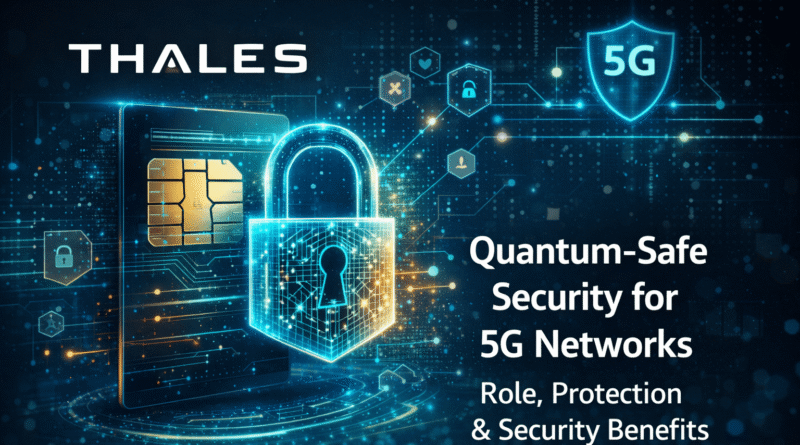
Thales Demonstrates Quantum-Safe Security for 5G Networks
The rapid development of quantum computing is expected to transform many areas of technology, but it also presents a significant challenge for cybersecurity. To address this emerging risk, the French technology company Thales Group has demonstrated what it describes as a world-first quantum-safe security approach for 5G networks, marking an important step toward protecting future mobile communications.
The innovation focuses on enabling post-quantum cryptographic protection for SIM and eSIM cards used in 5G networks, helping telecom operators strengthen security without needing to replace millions of devices already deployed worldwide.
Why Quantum Computing Is a Threat to Current Encryption
Most modern digital systems, including telecommunications networks, rely on widely used encryption algorithms to secure communications and sensitive data. However, powerful quantum computers could eventually break many of these encryption methods.
This creates potential risks for mobile communications, personal data, and critical infrastructure that depend on secure 5G connectivity.
Security experts warn that attackers could adopt a strategy called “harvest now, decrypt later.” In this scenario, encrypted data is collected today and stored until future quantum computers become capable of decrypting it.
As a result, telecom companies and cybersecurity experts are actively working on quantum-resistant or post-quantum cryptography solutions.
Thales’ Quantum-Safe Security Innovation
Thales has demonstrated a solution that allows post-quantum cryptographic algorithms to be remotely updated on existing SIM and eSIM cards used in 5G networks.
Instead of replacing physical SIM cards or hardware, the system allows telecom operators to download new encryption algorithms over the air, updating security protocols directly on deployed devices.
This capability introduces what is known as “crypto agility.”
Crypto agility allows network operators to:
- Upgrade encryption methods remotely
- Adapt to new security standards
- Protect devices without hardware replacement
- Maintain network services during upgrades
The technology ensures that mobile networks can evolve their security protections as new cryptographic threats emerge.
How the Technology Works
The key innovation demonstrated by Thales is the ability to deploy post-quantum cryptographic algorithms through remote updates.
These updates can be applied to:
- SIM cards
- eSIM cards
- mobile devices connected to 5G networks
The process occurs over the air and in the background, meaning there is no disruption to network services or user connectivity.
This approach helps telecom operators avoid the costly and complex task of physically replacing millions of SIM cards across their networks.
Importance for Telecom Operators and 5G Infrastructure
5G networks are expected to support a wide range of critical services, including:
- smart cities
- connected vehicles
- industrial IoT
- emergency communications
- financial and healthcare services
Because of this, maintaining strong security for mobile networks is essential.
The ability to upgrade cryptographic protections remotely allows telecom providers to protect long-term infrastructure investments while preparing for future cyber threats.
According to Thales, this innovation demonstrates that quantum-safe security can be implemented in existing 5G environments today, rather than waiting for new hardware generations.
Role of Post-Quantum Cryptography
Post-quantum cryptography refers to encryption methods designed to remain secure even against attacks from quantum computers.
Thales has been actively involved in research and development of quantum-resistant encryption technologies, contributing to global standardization initiatives such as those led by the National Institute of Standards and Technology (NIST).
These efforts aim to create globally accepted standards for cryptographic algorithms capable of protecting data in the quantum era.
Preparing 5G Networks for the Quantum Era
Although large-scale quantum computers capable of breaking current encryption are not yet operational, cybersecurity experts believe organizations should start preparing for the transition now.
Telecommunications networks face unique challenges because they support billions of devices worldwide, making large-scale hardware replacements impractical.
The ability to remotely upgrade encryption through software updates provides a practical path for telecom operators to gradually transition toward quantum-safe security.
Future Implications for Cybersecurity and Telecom
The demonstration by Thales highlights an important shift in how telecom security may evolve in the coming years.
As 5G networks continue to expand globally and become the backbone for digital services, the need for future-proof security solutions will only grow.
Quantum-safe cryptography and crypto-agile infrastructure could become key components of next-generation telecom security architectures.
For telecom operators, adopting these technologies early may help ensure long-term protection of mobile networks, customer data, and critical digital infrastructure.
Conclusion
The demonstration of quantum-safe security for 5G networks by Thales represents a major milestone in preparing telecommunications infrastructure for future quantum computing threats.
By enabling remote deployment of post-quantum cryptographic algorithms to SIM and eSIM cards, the company has shown that telecom networks can upgrade their security without replacing hardware or interrupting services.
As quantum computing continues to evolve, innovations like this will play an important role in ensuring that 5G networks remain secure, resilient, and capable of supporting critical digital services in the future.