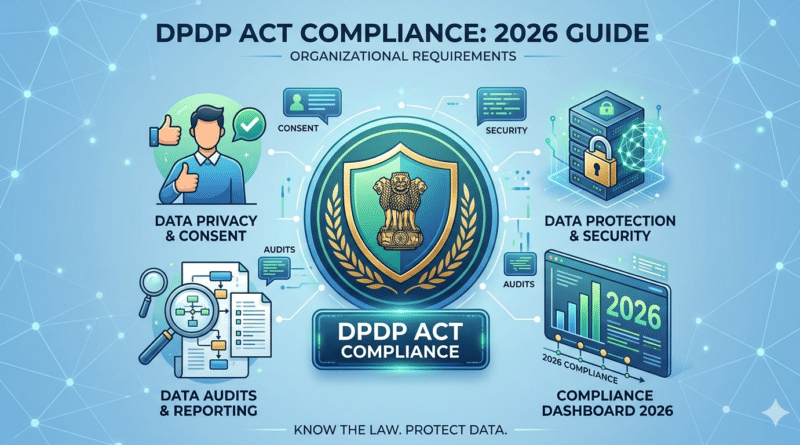
DPDP Act Compliance: Everything Organizations Need to Know in 2026
India’s data privacy landscape is undergoing a major transformation with the implementation of the Digital Personal Data Protection (DPDP) Act, 2023 and the accompanying DPDP Rules, 2025.
Organizations that collect, process, store, or share digital personal data of individuals in India must now establish robust privacy, consent, and security frameworks to remain compliant.
Whether you are a startup, enterprise, financial institution, e-commerce platform, healthcare provider, SaaS company, or government partner, understanding your obligations under the DPDP framework is critical.
This guide breaks down the key provisions, compliance requirements, implementation timelines, and practical steps organizations can take to build a privacy-first operating model.
What Is the DPDP Act, 2023?
The Digital Personal Data Protection Act, 2023 establishes the legal framework for processing digital personal data in India.
The law applies to:
- Personal data collected in digital form
- Offline personal data that is subsequently digitized
- Organizations processing personal data within India
- Organizations outside India that offer goods or services to individuals in India
The Act introduces several important concepts, including:
- Data Principal
- Data Fiduciary
- Data Processor
- Consent Manager
- Significant Data Fiduciary (SDF)
Understanding these roles is the foundation of any successful compliance program.
Why DPDP Compliance Matters
Non-compliance can result in significant financial penalties, operational disruptions, reputational damage, and regulatory scrutiny.
Potential consequences include:
- Monetary penalties reaching hundreds of crores for serious violations
- Suspension or restriction of data processing activities
- Increased customer distrust
- Legal and regulatory investigations
- Business continuity risks following data breaches
Organizations should view DPDP compliance not merely as a legal obligation but as a strategic business initiative that strengthens customer trust.
Key DPDP Compliance Requirements
1. Understand Your Data and Processing Activities
Organizations must identify:
- What personal data they collect
- Why the data is collected
- Where the data resides
- Who has access to it
- How long it is retained
- Which third parties process it
Creating a comprehensive data inventory and data flow map is the first step toward compliance.
2. Establish a Lawful Basis for Processing
Personal data can only be processed for lawful purposes.
Organizations must clearly determine whether processing is based on:
- Explicit consent
- Legitimate uses permitted under the Act
Every processing activity should have documented justification.
Notice Requirements Under DPDP
Before or at the time of collecting personal data, organizations must provide clear and understandable privacy notices.
A compliant notice should explain:
- What personal data is being collected
- Why the data is being collected
- What products or services the processing supports
- How individuals can withdraw consent
- How individuals can exercise their rights
- How complaints can be filed
Privacy notices should:
- Be written in plain language
- Be separate from lengthy terms and conditions
- Be available in multiple languages where required
- Be version controlled for audit purposes
Building a Compliant Consent Management Framework
Consent is central to the DPDP Act.
Valid consent must be:
- Free
- Specific
- Informed
- Unconditional
- Unambiguous
- Given through clear affirmative action
Organizations should ensure that:
- Consent is purpose-specific
- Pre-ticked checkboxes are avoided
- Consent records are stored securely
- Users can withdraw consent easily
- Consent withdrawal is as simple as giving consent
Maintaining an auditable consent trail is essential.
Key elements to record include:
- Timestamp
- Consent version
- Collection channel
- Processing purpose
- Withdrawal history
Legitimate Uses: When Consent Is Not Required
The DPDP Act permits processing without consent in certain circumstances.
Examples include:
- Compliance with legal obligations
- Medical emergencies
- Employment-related purposes
- Government functions
- Public interest scenarios
Organizations relying on legitimate uses should:
- Document the applicable legal provision
- Obtain internal legal approval
- Conduct periodic reassessments
- Maintain evidence supporting the decision
Data Fiduciary Obligations Under DPDP
Every data fiduciary must implement appropriate governance measures.
Core obligations include:
Data Accuracy
Organizations must take reasonable steps to ensure personal data is accurate and complete.
Security Safeguards
Required measures include:
- Encryption of data at rest and in transit
- Role-based access controls
- Centralized logging and monitoring
- Business continuity planning
- Data recovery capabilities
- Vendor risk management
Data Retention and Deletion
Personal data should only be retained as long as necessary for the stated purpose.
Organizations should establish:
- Data retention schedules
- Automated deletion workflows
- Periodic data reviews
- Secure disposal mechanisms
Breach Notification
Organizations must establish incident response processes to:
- Detect breaches quickly
- Investigate incidents
- Notify relevant authorities
- Inform affected individuals where required
A documented breach response playbook is essential.
Special Requirements for Children’s Data
The DPDP Act introduces stricter controls for processing children’s personal data.
Organizations must:
- Verify age before processing
- Obtain verifiable parental consent
- Disable behavioral monitoring for children
- Avoid targeted advertising to minors
Products and digital services aimed at children should embed privacy protections by design.
Significant Data Fiduciaries (SDFs): Additional Obligations
Certain organizations may be classified as Significant Data Fiduciaries based on factors such as:
- Volume of data processed
- Sensitivity of data
- Risk to individuals
- Impact on national interests
Additional requirements may include:
- Appointment of a Data Protection Officer
- Independent data audits
- Data Protection Impact Assessments (DPIAs)
- Enhanced governance controls
- Board-level oversight
Organizations should monitor regulatory notifications to determine whether they fall under this category.
DPDP Rules 2025: Key Compliance Deadlines
The DPDP Rules establish a phased implementation approach.
Organizations should prepare for three key timelines:
- Immediate compliance for procedural requirements
- Consent Manager requirements within 12 months
- Operational requirements within 18 months
Many organizations are targeting May 2027 as the primary deadline for implementing operational controls.
Delaying compliance efforts could significantly increase risk and implementation costs.
DPDP Compliance Checklist
Use this checklist to assess your readiness:
- Create a data inventory
- Map data flows across systems
- Classify processing activities
- Identify lawful processing grounds
- Update privacy notices
- Implement consent management processes
- Establish retention schedules
- Strengthen security controls
- Build breach notification workflows
- Review vendor agreements
- Implement children’s data safeguards
- Conduct DPIAs where required
- Assign ownership across legal, compliance, security, and technology teams
Best Practices for DPDP Readiness
Organizations that succeed in privacy compliance typically:
- Treat privacy as an ongoing program rather than a one-time project
- Establish cross-functional governance teams
- Automate consent and retention workflows
- Integrate privacy into product development
- Conduct regular compliance audits
- Train employees on privacy responsibilities
Privacy by design should become a core principle across all business processes.
Conclusion
The DPDP Act marks a significant shift in how organizations manage personal data in India.
Compliance requires more than policy updates—it demands operational changes across people, processes, and technology.
Organizations that begin their compliance journey early will be better positioned to reduce risk, strengthen customer trust, and build sustainable competitive advantage.
The time to prepare is now.
Frequently Asked Questions
-
Who must comply with the DPDP Act?
Any organization processing digital personal data of individuals in India must comply, including entities located outside India that offer goods or services to Indian residents.
-
What is a Data Fiduciary?
A Data Fiduciary is an organization or individual that determines the purpose and means of processing personal data.
-
Is consent mandatory for all data processing?
No. Certain legitimate uses allow processing without consent, provided specific legal conditions are met.
-
What are the penalties under the DPDP Act?
Penalties vary based on the nature of the violation and may extend to several hundred crores for serious non-compliance.
-
What is a Consent Manager?
A Consent Manager is an entity registered under the DPDP framework that enables individuals to provide, manage, review, and withdraw consent.
-
What is the deadline for DPDP compliance?
While implementation timelines vary by requirement, many operational obligations are expected to become enforceable by May 2027.