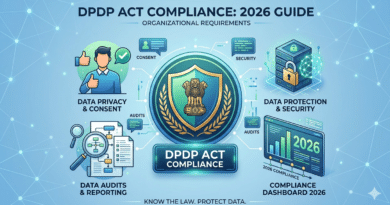
Responsibilities of CISOs and DPOs Under India’s DPDP Act: Roles, Challenges, Framework, Consent Management & Penalties
As India’s digital ecosystem grows, data protection is no longer just a legal checkbox—it’s a core business responsibility. The Digital Personal Data Protection (DPDP) Act places clear accountability on organizations to protect personal data, respect user consent, and respond transparently to breaches.
At the heart of this responsibility are two critical roles: the Chief Information Security Officer (CISO) and the Data Protection Officer (DPO). This guide explains their responsibilities, implementation challenges, DPDP framework, consent management, automation through data security tools, and penalties for non-compliance.
Understanding the DPDP Act (High-Level Overview)
The DPDP Act governs how organizations:
- Collect, process, store, and delete digital personal data
- Obtain and manage user consent
- Protect data against breaches
- Ensure accountability and transparency
It applies to:
- Indian organizations processing digital personal data
- Foreign entities processing data of individuals located in India
Roles & Responsibilities: CISO vs DPO
While both roles collaborate closely, their focus areas differ.
Responsibilities of a CISO under DPDP
The CISO is primarily responsible for data security and risk management.
Key responsibilities include:
- Designing and enforcing information security architecture
- Implementing technical safeguards (encryption, access controls, DLP, IAM)
- Ensuring secure data storage, transmission, and disposal
- Managing incident detection, response, and breach containment
- Conducting regular risk assessments and vulnerability testing
- Supporting audits and compliance reporting from a security standpoint
- Ensuring third-party and vendor security compliance
👉 In short: CISO = “How data is protected”
Responsibilities of a DPO under DPDP
The DPO focuses on lawful processing and privacy governance.
Key responsibilities include:
- Interpreting DPDP obligations and advising the organization
- Ensuring personal data is processed lawfully and purpose-limited
- Overseeing consent lifecycle management
- Acting as the point of contact for data principals (users) and regulators
- Managing data subject rights (access, correction, erasure, grievance)
- Conducting privacy impact assessments
- Coordinating breach notifications with authorities
👉 In short: DPO = “Why and whether data can be processed”
Initial Challenges in DPDP Implementation
Organizations often face these early hurdles:
1. Data Discovery & Classification
- Lack of visibility into where personal data resides
- Unstructured data spread across email, endpoints, cloud apps
2. Consent Traceability
- Difficulty mapping consent to specific data records
- Legacy systems not designed for consent-based processing
3. Role & Ownership Confusion
- Overlap between legal, IT, security, and compliance teams
- No clear accountability model
4. Vendor & Third-Party Risks
- Data shared with processors without DPDP-aligned controls
- Limited monitoring of vendor compliance
5. Automation Gaps
- Manual processes for access requests and consent tracking
- High operational overhead and error risk
DPDP Compliance Framework (Practical View)
A structured DPDP framework typically includes:
1. Governance & Policy Layer
- Data protection policy
- Privacy notice & consent policy
- Breach response and retention policy
2. Data Lifecycle Management
- Collection → Processing → Storage → Sharing → Deletion
- Purpose limitation and data minimization
3. Consent Management
- Capture
- Verification
- Withdrawal
- Audit trail
4. Security Controls
- Encryption (data at rest & in transit)
- Role-based access control
- Continuous monitoring
5. Incident & Breach Management
- Detection
- Assessment
- Notification
- Remediation
Implementing Consent Management Effectively
Consent is the foundation of DPDP compliance.
Key Principles of DPDP Consent
Consent must be:
- Free
- Specific
- Informed
- Unambiguous
- Revocable
How Organizations Should Implement Consent Management
Best practices:
- Use centralized Consent Management Platforms (CMPs)
- Store consent metadata (who, when, why, how)
- Map consent to each processing purpose
- Provide easy mechanisms for withdrawal
- Maintain logs for regulatory audits
Who Are Consent Managers?
Consent Managers are entities authorized by the government to:
- Act as a neutral intermediary between individuals and organizations
- Enable users to give, review, withdraw, and manage consent in one place
- Ensure standardized, interoperable consent records
Role of Consent Managers
- Secure consent artifacts
- Provide audit-ready consent trails
- Reduce compliance burden on organizations
- Increase transparency for users
Organizations may integrate their systems with registered consent managers once notified by authorities.
Automating DPDP Compliance Through Data Security Tools
Manual compliance does not scale. Automation is essential.
Key Security Tools Used for DPDP Automation
1. Data Discovery & Classification Tools
- Identify personal and sensitive data
- Tag data based on risk and regulation
2. Data Loss Prevention (DLP)
- Prevent unauthorized data sharing
- Enforce consent-based access
3. Identity & Access Management (IAM)
- Role-based and least-privilege access
- Strong authentication for data handlers
4. Encryption & Key Management
- Protect data across endpoints, databases, and cloud
5. Privacy & DSPM Platforms
- Monitor data usage
- Map data flows
- Automate access/erasure requests
Benefits of Automation
- Reduced compliance cost
- Faster response to data principal requests
- Real-time compliance visibility
- Audit readiness
Penalties & Fines Under DPDP Act
Failure to comply with DPDP obligations can result in significant financial penalties.
Indicative Penalties Include:
- Failure to protect personal data:
Penalties can go up to ₹250 crore, depending on severity and impact - Failure to notify data breaches
- Non-fulfilment of user rights
- Processing data without valid consent
- Non-compliance by significant data fiduciaries
⚠️ Penalties are discretionary and proportional, based on:
- Nature of violation
- Duration
- Number of affected individuals
- Preventive measures taken
Final Thoughts: Collaboration Is the Key
DPDP compliance is not just a legal task—it’s a cross-functional transformation.
- CISOs must ensure strong security architecture and automation
- DPOs must ensure lawful processing, consent governance, and user trust
- Together, they build a privacy-by-design culture
Organizations that act early will not only avoid penalties—but also gain customer trust, operational efficiency, and regulatory confidence.