
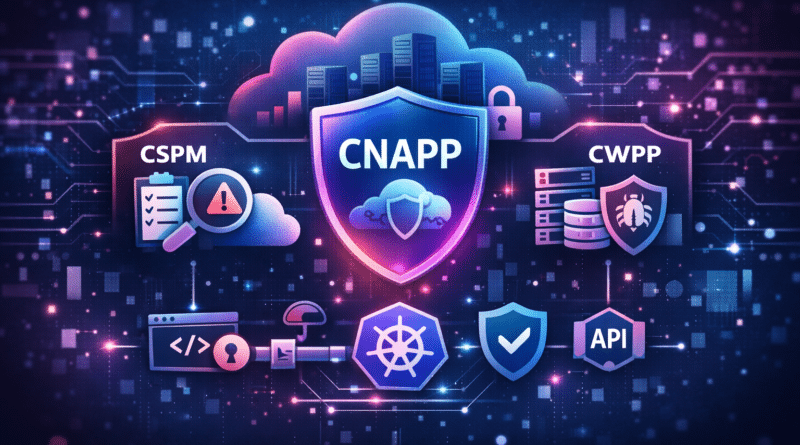
CSPM vs CWPP vs CNAPP Explained: Complete Cloud Security Guide for Enterprises (2026)
Introduction
As enterprises accelerate cloud adoption, security challenges are evolving just as fast. Misconfigurations, unsecured workloads, and lack of visibility are now among the top causes of data breaches.
Two critical solutions—Cloud Security Posture Management (CSPM) and Cloud Workload Protection Platforms (CWPP)—have emerged to address these risks. But with the rise of Cloud-Native Application Protection Platforms (CNAPP), organizations are asking:
👉 Are CSPM and CWPP still relevant, or are they now part of something bigger?
Let’s break it down.
What is Cloud Security Posture Management (CSPM)?


Cloud Security Posture Management (CSPM) focuses on identifying and fixing misconfigurations in cloud environments.
Key Capabilities:
- Continuous monitoring of cloud configurations
- Detection of misconfigurations (e.g., open S3 buckets, exposed databases)
- Compliance checks (ISO 27001, GDPR, HIPAA, etc.)
- Automated remediation and policy enforcement
Why CSPM Matters:
Misconfigurations are one of the leading causes of cloud breaches. CSPM ensures your infrastructure is always aligned with security best practices.
Example Risks CSPM Solves:
- Publicly exposed storage
- Weak IAM policies
- Unencrypted data at rest
- Over-permissive access controls
What is Cloud Workload Protection Platform (CWPP)?

Cloud Workload Protection Platform (CWPP) secures workloads running in the cloud, including:
- Virtual Machines (VMs)
- Containers
- Serverless workloads
Key Capabilities:
- Runtime threat detection
- Vulnerability management
- Malware protection
- Behavioral monitoring
- Host-based intrusion detection
Why CWPP Matters:
Even if your cloud is configured correctly, attacks can still occur at runtime. CWPP protects workloads from active threats.
Example Threats CWPP Stops:
- Malware infections
- Crypto-mining attacks
- Container escape attempts
- Zero-day exploits
CSPM vs CWPP: Key Differences
| Feature | CSPM | CWPP |
|---|---|---|
| Focus | Cloud configuration | Workload runtime security |
| Layer | Infrastructure | Compute workloads |
| Primary Risk | Misconfiguration | Active threats |
| Timing | Pre-breach prevention | During/after attack detection |
| Coverage | Cloud accounts/services | VMs, containers, serverless |
👉 In simple terms:
- CSPM = Prevent mistakes
- CWPP = Stop attacks
What is CNAPP (Cloud-Native Application Protection Platform)?

Cloud-Native Application Protection Platform (CNAPP) is a unified security framework that integrates multiple cloud security capabilities into a single platform.
CNAPP Combines:
- CSPM (posture management)
- CWPP (workload protection)
- CI/CD security
- Infrastructure as Code (IaC) scanning
- API security
- Identity & entitlement management (CIEM)
Key Idea:
👉 CNAPP provides end-to-end cloud security from development to runtime.
Are CSPM and CWPP Part of CNAPP?
✅ Yes — CSPM and CWPP are core building blocks of CNAPP.
CNAPP doesn’t replace them—it integrates and enhances them.
Evolution Path:
- CSPM (fix misconfigurations)
- CWPP (protect workloads)
- CNAPP (unified, full lifecycle security)
Why CNAPP Matters:
- Eliminates siloed security tools
- Provides centralized visibility
- Enables DevSecOps integration
- Improves risk prioritization across environments
How CSPM + CWPP Fit into Your Cybersecurity Roadmap
To align with a modern enterprise cybersecurity strategy, you should think in phases:
Phase 1: Visibility & Posture (CSPM)
- Identify misconfigurations
- Ensure compliance
- Reduce attack surface
Phase 2: Workload Protection (CWPP)
- Protect runtime environments
- Detect and respond to threats
- Secure containers and VMs
Phase 3: Unified Security (CNAPP)
- Integrate security across lifecycle
- Enable DevSecOps
- Automate risk prioritization
Benefits of Adopting CNAPP with CSPM & CWPP
- 🔒 Holistic Cloud Security
- ⚡ Faster Threat Detection & Response
- 📊 Centralized Risk Visibility
- 🔁 Automation & Scalability
- 🧩 Reduced Tool Sprawl
Challenges to Consider
- Integration complexity in multi-cloud environments
- Skill gaps in cloud-native security
- False positives if not tuned properly
- Cost of platform consolidation
Best Practices for Enterprises
- Adopt a DevSecOps approach
- Continuously monitor configurations and workloads
- Prioritize risks based on business impact
- Integrate CNAPP with SIEM/SOAR platforms
- Regularly audit cloud environments
Final Thoughts: Why CNAPP is Essential in 2026 Cybersecurity Strategy
Cloud security is no longer just about protecting infrastructure—it’s about securing the entire application lifecycle.
CSPM and CWPP remain critical, but their true power is unlocked when unified under CNAPP.
👉 For enterprises building a Cybersecurity Roadmap, CNAPP should be a core pillar, ensuring:
- Prevention (CSPM)
- Protection (CWPP)
- Unified visibility & control (CNAPP)