Application Security for Enterprises: Components, Tools & Best Practices Explained
In today’s digital-first enterprise environment, applications—whether web, mobile, or APIs—are the primary interface between businesses and users. As organizations accelerate digital transformation, applications have also become the most targeted attack surface for cybercriminals.
This makes Application Security (AppSec) a critical pillar in any enterprise cybersecurity roadmap. A single vulnerability in an application can lead to data breaches, financial loss, compliance issues, and reputational damage.
This article provides a comprehensive overview of Application Security, covering its key components, testing methodologies like SAST/DAST/VAPT, tools, and best practices for enterprises.
🧩 What is Application Security?
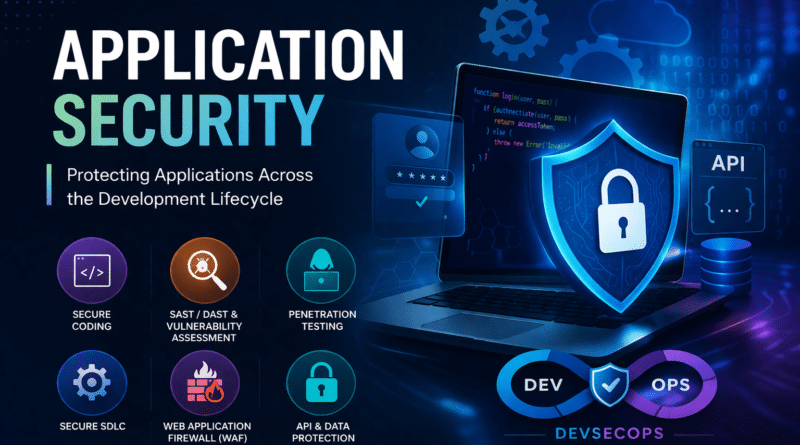
Application Security refers to the process of identifying, fixing, and preventing security vulnerabilities in applications throughout their lifecycle—from design and development to deployment and maintenance.
Unlike traditional security approaches that focus only on infrastructure, AppSec ensures that the application itself is secure from internal and external threats.
🏗️ Key Components of Application Security
🔧 Core Building Blocks


1. Secure Software Development Lifecycle (SSDLC)
Security must be embedded into every phase of development:
- Requirement Phase: Define security requirements
- Design Phase: Threat modeling and architecture review
- Development Phase: Secure coding practices
- Testing Phase: Security testing (SAST, DAST, etc.)
- Deployment & Maintenance: Continuous monitoring and patching
👉 This approach is often called “Shift Left Security”, where vulnerabilities are addressed early.
2. Identity & Access Management (IAM)
IAM ensures that only authorized users can access application resources:
- Authentication (passwords, MFA, biometrics)
- Authorization (RBAC, ABAC)
- Session management
3. API Security
With the rise of microservices, APIs are a major attack vector:
- Secure authentication (OAuth 2.0, JWT)
- Rate limiting and throttling
- API gateways and monitoring
4. Data Security
Protecting sensitive data is critical:
- Encryption (at rest and in transit)
- Key management systems (KMS)
- Data masking and tokenization
5. Application Layer Security Controls
- Web Application Firewall (WAF): Filters malicious traffic
- RASP: Protects applications during runtime
- Bot protection: Prevents automated attacks
6. Logging, Monitoring & Incident Response
- Centralized logging
- Integration with SIEM/SOC
- Real-time alerting and response
🛠️ Application Security Testing Methods
⚙️ Security Testing Techniques Explained

🔍 1. SAST (Static Application Security Testing)
- Scans source code, bytecode, or binaries
- Detects vulnerabilities early (e.g., insecure coding practices)
- Best used during development
Benefits:
- Early detection
- Cost-effective remediation
🌐 2. DAST (Dynamic Application Security Testing)
- Tests running applications externally
- Simulates real-world attacks
Finds:
- SQL Injection
- Cross-Site Scripting (XSS)
- Authentication flaws
🔄 3. IAST (Interactive Application Security Testing)
- Combines SAST + DAST
- Works inside the application runtime
- Provides accurate, real-time results
📦 4. SCA (Software Composition Analysis)
- Identifies vulnerabilities in open-source libraries
- Critical due to heavy dependency usage in modern apps
🧪 5. Vulnerability Assessment (VA)
- Automated scanning for known vulnerabilities
- Conducted regularly (monthly/quarterly)
🎯 6. Penetration Testing (VAPT)
- Simulates real cyberattacks
- Identifies exploitable vulnerabilities
Types:
- Black box
- White box
- Grey box
👉 Provides business impact and risk prioritization.
🧬 7. RASP (Runtime Application Self-Protection)
- Embedded into the application
- Detects and blocks attacks in real time
🛡️ 8. Web Application Firewall (WAF)
- Protects applications from OWASP Top 10 threats
- Acts as a shield between users and servers
🧰 Popular Application Security Tools
| Category | Tools |
|---|---|
| SAST | Checkmarx, Fortify, SonarQube |
| DAST | Burp Suite, Acunetix, Netsparker |
| SCA | Snyk, Black Duck |
| WAF | Cloudflare WAF, AWS WAF, Imperva |
| RASP | Contrast Security |
| VAPT | Manual + tools like Metasploit |
🔄 DevSecOps: Integrating Security into CI/CD
Modern enterprises adopt DevSecOps, where security is integrated into development pipelines:
- Automated code scanning during build
- Security gates before deployment
- Continuous monitoring post-deployment
👉 This ensures continuous security instead of periodic testing.
📋 Best Practices for Enterprise Application Security
✔️ Follow OWASP Top 10
- Protect against common threats like:
- Injection
- Broken authentication
- Sensitive data exposure
✔️ Implement Secure Coding Standards
- Input validation
- Output encoding
- Avoid hardcoded credentials
✔️ Regular VAPT & Audits
- Conduct periodic testing
- Fix vulnerabilities promptly
✔️ Patch Management
- Keep libraries and frameworks updated
- Monitor CVEs
✔️ Zero Trust Approach
- Verify every access request
- Minimize trust boundaries
✔️ Security Awareness for Developers
- Train teams on secure coding
- Promote security-first culture
⚖️ Challenges in Application Security
- Rapid development cycles (Agile/DevOps)
- Complex microservices architecture
- Increasing use of third-party libraries
- Lack of skilled AppSec professionals
🏁 Conclusion
Application Security is no longer a secondary function—it is a core requirement for enterprise resilience. With cyber threats evolving rapidly, organizations must adopt a multi-layered, proactive approach that combines:
- Secure development practices
- Advanced testing techniques (SAST, DAST, VAPT)
- Runtime protection mechanisms
- Continuous monitoring and improvement
A well-implemented AppSec strategy not only protects applications but also ensures business continuity, regulatory compliance, and customer trust.
💬 Final Thought
Enterprises that invest in strong application security today are not just preventing attacks—they are building a foundation for secure digital growth.