
Even Without Internet Access, Air-Gapped Networks Are Still at Risk: Here’s How
For years, air-gapped networks—systems completely isolated from the internet—have been treated as the ultimate cybersecurity safeguard. From nuclear facilities and power plants to manufacturing floors and defense systems, organizations have relied on physical isolation to protect critical operations.
But history and recent research tell a clear story: air-gapped networks are not immune to cyberattacks. While isolation lowers risk, it does not eliminate it. Attackers have learned to exploit indirect access paths—often through people, trusted tools, and routine operational processes.
Related Post : Top 5 Cyber Threats Every Enterprise Must Prepare for in 2026
The Illusion of “Offline Security”
An air-gapped network has no direct connection to the internet or corporate IT infrastructure. In theory, this blocks remote attacks entirely. In reality, these environments still depend on:
- Software and firmware updates
- Maintenance and diagnostics
- Vendor and contractor access
- Data transfers using removable media
Each of these necessities creates an opportunity for compromise.
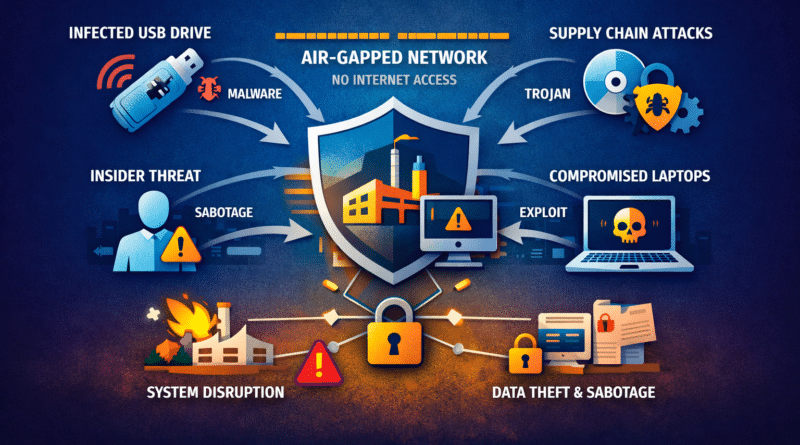
How Attackers Breach Air-Gapped Networks
Removable Media: The Most Proven Attack Vector
USB drives remain the most common way malware crosses an air gap. Engineers frequently use removable media to upload PLC logic, install updates, or collect logs. If that USB device is infected on a connected system, it can introduce malware into an isolated environment.
This method is not theoretical—it has already been used in real attacks.
Real-World Example: Stuxnet
The Stuxnet attack remains the most famous example of an air-gap breach. The malware was introduced into Iran’s nuclear facilities through infected USB drives and went on to manipulate industrial controllers, physically damaging centrifuges while reporting normal readings to operators.
Stuxnet proved a critical lesson: air gaps slow attackers, but they do not stop them.
Maintenance Laptops as Hidden Bridges
Another frequent weak point is the use of engineering laptops that move between IT and OT environments. These systems often connect to the internet or corporate networks and later to air-gapped systems for maintenance.
If compromised, these laptops act as silent bridges, carrying malware across environments.
Once inside, attackers benefit from the high privileges typically granted to engineering tools, making detection extremely difficult.
Supply Chain and Trusted Update Attacks
Air-gapped systems still trust vendor software and firmware. Attackers increasingly target suppliers, inserting malicious code into legitimate updates or tools.
Real-World Example: Supply-Chain Attacks on Industrial Systems
While not always strictly air-gapped, incidents like SolarWinds demonstrated how trusted software updates can be weaponized. In industrial and OT contexts, similar techniques could introduce malware into isolated systems during routine maintenance.
Because these updates appear legitimate, malicious code can persist undetected for long periods.
Insider Threats—Accidental and Malicious
Not all breaches originate from outside attackers. Insiders—employees, contractors, or third-party technicians—can unintentionally introduce malware or make unsafe changes. In rare cases, insiders may act deliberately.
Air-gapped environments often lack detailed logging and monitoring, making insider activity harder to trace.
Temporary Connectivity That Leaves Permanent Risk
Some air-gapped networks are temporarily connected for remote support or emergency troubleshooting. These short-term connections, if poorly secured or not fully removed, can leave behind vulnerabilities or backdoors.
Security teams often underestimate how quickly attackers can exploit even brief exposure.
What Happens When an Air-Gapped Network Is Compromised?
The impact can be severe—often more serious than a typical IT breach:
- Manipulation of industrial processes
- Production shutdowns and financial losses
- Equipment damage and safety incidents
- Theft of proprietary designs or process data
- Long-term hidden sabotage
Real-World Context: Power Grid Attacks
Malware such as Industroyer (CrashOverride), used in attacks on Ukraine’s power grid, showed how industrial systems can be disrupted through targeted OT malware. While not purely air-gapped, these incidents highlight the real-world consequences of attacks on isolated operational environments.
How Organizations Can Reduce the Risk
Security experts stress that air gaps must be supported by layered controls, not treated as a standalone defense.
Key measures include:
- Strict removable media controls, including scanning and approval
- Dedicated laptops and tools for air-gapped environments
- Strong role-based access and change management
- Verification of software and firmware integrity before deployment
- Passive monitoring and anomaly detection within OT networks
- Incident response plans tailored specifically for isolated systems
The focus should be on visibility, discipline, and process control, not just isolation.
The Bottom Line
Air-gapped networks remain an important security measure—but they are no longer a guarantee of safety. Real-world incidents like Stuxnet and targeted industrial malware campaigns have shown that attackers will exploit human behavior, trusted workflows, and supply chains to reach even the most isolated systems.
For organizations operating critical infrastructure, the message is clear: security does not end at the air gap. True resilience comes from combining isolation with strong governance, continuous monitoring, and realistic threat awareness.