Top 5 Cyber Threats Every Enterprise Must Prepare for in 2026
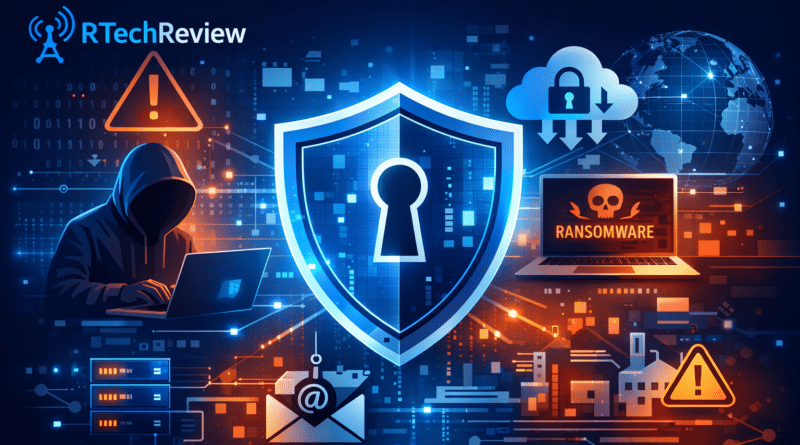
As enterprises continue to digitize operations, move workloads to the cloud, and adopt remote and hybrid work models, the cyber-attack surface has expanded dramatically. Cybercriminals and state-sponsored threat actors are taking advantage of this complexity, launching attacks that are more targeted, persistent, and damaging than ever before.
Today’s enterprise cyber threats are not limited to simple malware infections. They include ransomware campaigns that halt business operations, sophisticated phishing attacks that bypass traditional defenses, and supply-chain compromises that exploit trusted vendors.
In this article, we explore the top five cyber threats facing enterprises, identify who the threat actors are, explain the techniques they use, examine real-world compromise examples, and outline practical steps enterprises can take to defend themselves.
1. Ransomware Attacks and Ransomware-as-a-Service (RaaS)
Who are the threat actors?
Ransomware attacks are typically carried out by organized cybercriminal groups operating under a Ransomware-as-a-Service (RaaS) model. These groups develop ransomware and lease it to affiliates who carry out attacks for a share of the profits.
Techniques used
- Phishing emails with malicious attachments or links
- Exploiting exposed RDP, VPNs, or unpatched systems
- Credential theft and lateral movement inside networks
- Data exfiltration followed by encryption (double extortion)
Impact on enterprises
- Complete business disruption and downtime
- Loss of sensitive customer and corporate data
- Financial losses due to ransom payments and recovery
- Regulatory penalties and reputational damage
Real-world example
The Colonial Pipeline ransomware attack disrupted fuel supply across the U.S., showing how a single compromised credential can impact critical infrastructure and the broader economy.
How enterprises can defend
- Enforce multi-factor authentication (MFA) on all access points
- Maintain offline and immutable backups
- Segment networks to limit lateral movement
- Deploy endpoint detection and response (EDR) solutions
2. Supply-Chain and Third-Party Attacks
Who are the threat actors?
Supply-chain attacks are often linked to advanced persistent threat (APT) groups or highly skilled cybercriminals targeting software vendors and service providers.
Techniques used
- Injecting malicious code into trusted software updates
- Compromising vendor build systems or CI/CD pipelines
- Exploiting weak security practices of third-party providers
Impact on enterprises
- Silent, long-term access to enterprise networks
- Widespread compromise affecting multiple organizations
- Costly remediation and loss of trust in vendors
Real-world example
The SolarWinds compromise allowed attackers to infiltrate thousands of organizations by abusing trusted software updates.
How enterprises can defend
- Perform regular third-party risk assessments
- Require vendors to follow strong security standards
- Monitor outbound connections and unusual vendor activity
- Implement least-privilege access for vendor accounts
3. Phishing and Business Email Compromise (BEC)
Who are the threat actors?
Phishing and BEC attacks are commonly conducted by cybercriminal gangs specializing in social engineering and financial fraud.
Techniques used
- Highly targeted spear-phishing emails
- Credential harvesting via fake login pages
- CEO or finance impersonation for fraudulent payments
- AI-generated emails and voice deepfakes
Impact on enterprises
- Financial losses due to fraudulent transactions
- Account takeovers and data exposure
- Entry point for larger cyberattacks
Real-world example
Business Email Compromise scams cost organizations billions of dollars globally each year, making it one of the most financially damaging attack types.
How enterprises can defend
- Deploy email authentication (SPF, DKIM, DMARC)
- Conduct regular phishing awareness training
- Use multi-step approval for financial transactions
- Monitor for unusual login behavior and email rules
4. Cloud Security Misconfigurations
Who are the threat actors?
Cloud attacks are often launched by opportunistic attackers and ransomware groups scanning for exposed cloud assets.
Techniques used
- Exploiting misconfigured storage buckets
- Abusing excessive IAM permissions
- Stealing cloud access keys and tokens
- Deploying cryptominers or exfiltrating data
Impact on enterprises
- Large-scale data leaks
- Unexpected cloud costs
- Service outages and compliance violations
How enterprises can defend
- Apply least-privilege access controls
- Use cloud security posture management (CSPM) tools
- Enable detailed logging and monitoring
- Encrypt sensitive data by default
5. Nation-State and Advanced Persistent Threat (APT) Attacks
Who are the threat actors?
These attacks are carried out by state-sponsored groups focused on espionage, intellectual property theft, or long-term strategic advantage.
Techniques used
- Zero-day exploits and custom malware
- Long-term reconnaissance and stealthy persistence
- Living-off-the-land techniques using legitimate tools
- Social engineering through job offers or partnerships
Impact on enterprises
- Theft of proprietary technology and trade secrets
- Loss of competitive advantage
- Long-term undetected compromise
Real-world example
Multiple APT groups have targeted defense, telecom, and technology firms using fake job offers and trojanized files to steal sensitive data.
How enterprises can defend
- Use threat intelligence and behavioral analytics
- Monitor privileged access continuously
- Conduct red-team and tabletop exercises
- Align defenses with MITRE ATT&CK techniques
📣 We’ve opened a dedicated discussion thread in the RTechReview Community Forum where readers can share insights, experiences, and predictions:
👉 Top Cyber Threats Enterprises Face in 2026 – Who Are the Active Threat Actors?
Final Thoughts: Building Enterprise Cyber Resilience
Enterprise cyber threats are becoming more complex, persistent, and costly. No single security tool can prevent all attacks. Instead, organizations must adopt a layered defense strategy that combines technology, process, and people.
By understanding who the attackers are, how they operate, and where enterprises are most vulnerable, security teams can prioritize investments and build resilient systems capable of detecting, responding to, and recovering from modern cyberattacks.
Cybersecurity is no longer just an IT concern—it is a business imperative.