
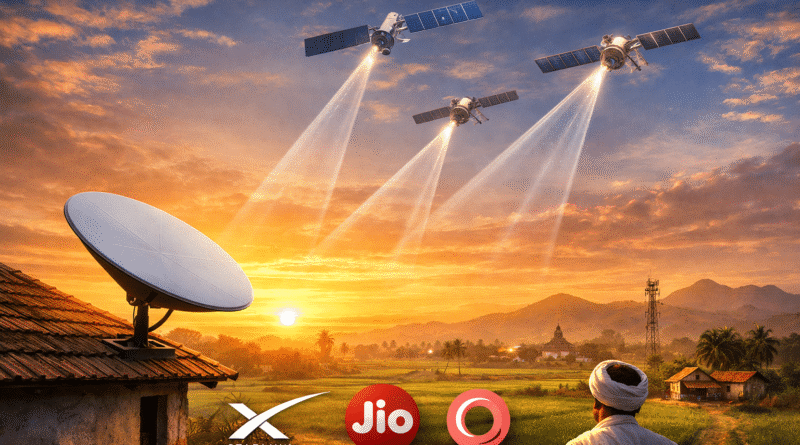
Satellite Internet in India 2026: Starlink, Jio-SES, OneWeb Boom
India is on the brink of a major digital connectivity revolution as satellite-based internet services — long talked about but never commercially available — prepare for rollout across the country. After years of regulatory negotiations, trials and spectrum approvals, three major players — Starlink (SpaceX), Jio-SES (Reliance & SES partnership) and Eutelsat-OneWeb — are closing in on commercial launches that could redefine broadband access, especially in rural and underserved regions.
Industry insiders say 2026 may be the year satellite communication becomes a consumer reality in India as providers move from pilot tests to full-scale offerings to homes, businesses, and enterprises alike.
Moves to Launch: Who’s Coming & Timeline
- Starlink: Elon Musk’s satellite broadband arm has received key regulatory clearances and started security tests, marking one of the final hurdles before service can begin. Officials suggest that commercial deployment could happen by early 2026 once final approvals from the Telecom Regulatory Authority of India (TRAI) are in place.
- Jio-SES / JioSpaceFiber: Reliance’s space broadband venture has demonstrated satellite-based gigabit connectivity and holds licences to launch services, with a strategy focused on complementing Jio’s existing terrestrial network footprint.
- Eutelsat-OneWeb: The Bharti Airtel-backed OneWeb constellation continues trials and holds spectrum access extensions, keeping it in the race to deliver satellite internet to Indian users.
Officials and experts say that once final spectrum allocation and pricing frameworks are issued by authorities — expected in early 2026 — these services will rapidly shift from concept to consumer availability.
Pricing: Early Numbers & Caution on Accuracy
Starlink’s India portal briefly displayed residential pricing, suggesting a monthly tariff of around ₹8,600 and a one-time hardware cost near ₹34,000 for the satellite kit — including dish and router — with promotions such as a 30-day trial period.
However, Starlink later clarified that these figures were shown due to a website “configuration glitch” and do not represent official, finalized pricing. The company has confirmed that pricing has not yet been formally announced and the service is not yet live.
Other industry reports suggest that, once fully approved, Starlink may offer multiple service tiers starting at a lower range (roughly ₹2,500–₹3,500 per month for retail customers), though these figures remain indicative and subject to change after official launch.
Pricing details for Jio-SES and OneWeb services are not yet publicly disclosed, though both are expected to target a mix of enterprise, government and consumer segments at competitive rates once launched.
What Satellite Internet Will Change
For millions of Indians still waiting for reliable broadband, satellite internet could be a gamechanger:
1. Nationwide Coverage
Satellite networks can beam internet to districts where laying fiber or extending 4G/5G has been commercially challenging, such as remote valleys, tribal belts, islands and high-altitude areas.
2. Better Speeds & Reliability
Newer Low Earth Orbit (LEO) and Medium Earth Orbit (MEO) satellite constellations — unlike older geostationary systems — offer improved speeds and lower response times. This makes video calls, tele-education and real-time services far more feasible.
3. Quick Deployment
Users in distant hamlets only need a satellite terminal and connection point. Without needing extensive ground infrastructure, service can be live within hours, compared with months or years for fiber rollouts.
Who Should Consider Satellite Broadband
Ideal candidates:
- Residents in remote or hilly regions with little or no fiber or 5G broadband.
- Schools, clinics and government centres in connectivity deserts.
- Enterprises in maritime, aviation or mining sectors needing reliable global links.
Less ideal for now:
- Urban or suburban users already on high-speed fiber or 5G networks, unless satellite broadband becomes dramatically more cost-competitive.
Benefits and Challenges
Benefits include:
- Universal reach irrespective of terrain.
- Disaster resilience, with connectivity even when ground networks fail.
- New opportunities in e-learning, telehealth, e-commerce and agriculture tech.
Challenges to watch:
- Price sensitivity: early satellite plans are likely to be costlier than typical fiber packages.
- Capacity constraints: initial satellite fleets may limit simultaneous high-speed access in dense areas.
- Hardware dependencies: receivers and installation still require upfront investment.
Market Outlook and Competition
With Starlink, Jio-SES and OneWeb all preparing offerings, the satellite broadband landscape in India is shifting rapidly from promise to reality. Analysts believe this competition will not only broaden the connectivity map of the country but eventually drive innovation and affordability across tiers of users.
Experts also note that the government’s approach to spectrum pricing and allocation will be a key determinant of how fast and widely these services spread.
Conclusion
As India moves into 2026, satellite internet is no longer a distant dream — it’s nearing commercial rollout. Whether you live atop a Himalayan village or run a business on a coastal island, these technologies promise to bridge long-standing digital gaps. But potential customers should be aware: early pricing figures remain indicative and subject to final regulatory approval and official announcement, especially on platforms like Starlink’s website.
Stay tuned as the country readies for a new era of connectivity where the sky itself becomes the next broadband frontier.