AI-Powered Cyberattacks Becoming Industrial Scale: Cybersecurity Enters a New Era
Artificial Intelligence is no longer just helping businesses improve productivity or automate operations. In 2026, AI is now transforming the cybercrime ecosystem at an alarming pace.
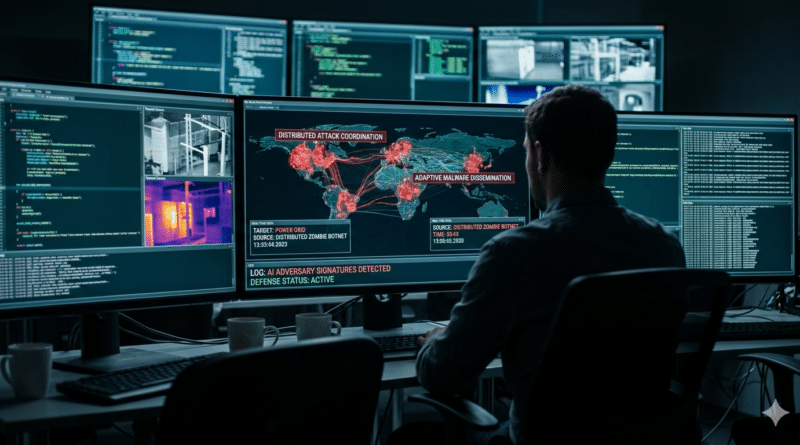
Security researchers and global technology companies are warning that AI-powered cyberattacks are becoming “industrial scale,” allowing attackers to automate hacking operations faster and more efficiently than ever before. Even more concerning, cybersecurity experts have reportedly identified what may be the world’s first AI-generated zero-day vulnerability — a major milestone that signals a dramatic shift in modern cyber warfare.
The development is sending shockwaves across the cybersecurity industry, governments, telecom providers, and enterprise IT teams worldwide.
What Are AI-Powered Cyberattacks?
Traditionally, cyberattacks required skilled hackers manually writing malicious code, discovering vulnerabilities, and launching attacks. However, with the rise of generative AI and advanced language models, many of these activities can now be partially automated.
Today’s AI-driven cyber tools can:
- Generate phishing emails within seconds
- Create malware variants automatically
- Scan for vulnerabilities at massive scale
- Write exploit code
- Mimic human communication using deepfake voice and video
- Adapt attacks dynamically to bypass security controls
Cybersecurity analysts say this is reducing the technical barrier for attackers while dramatically increasing the speed and volume of attacks.
According to recent global threat intelligence reports, criminal organizations and even state-sponsored groups are now actively integrating AI into their offensive cyber operations.
First AI-Generated Zero-Day Vulnerability Discovered
One of the most significant developments in recent weeks is the discovery of a reportedly AI-generated zero-day exploit.
A zero-day vulnerability refers to a security flaw that is unknown to software vendors and has no available patch at the time of discovery. These vulnerabilities are considered extremely dangerous because attackers can exploit them before organizations have time to defend themselves.
Researchers revealed that advanced AI systems were capable of:
- Identifying hidden logic flaws
- Generating exploit chains automatically
- Adapting attack methods in real-time
- Assisting in bypassing authentication protections
While experts clarify that humans were still involved in the process, the role of AI in accelerating vulnerability discovery is raising serious concerns within the cybersecurity community.
This marks the beginning of a new phase where AI may not only assist attackers but actively participate in vulnerability research and exploit development.
Related Article – Cybersecurity Roadmap for Enterprises: Complete Security Strategy Guide
Rise of Self-Morphing Malware
Another emerging threat gaining attention is self-morphing malware.
Unlike traditional malware, which typically maintains a fixed signature, AI-enhanced malware can reportedly modify its own behavior and code structure dynamically. This allows it to evade traditional antivirus tools and signature-based detection systems.
Security experts believe future malware may soon:
- Rewrite itself continuously
- Change attack patterns automatically
- Detect sandbox environments
- Learn from failed attack attempts
- Customize attacks against specific organizations
This evolution could significantly challenge existing cybersecurity defenses.
Ransomware Attacks Becoming More Sophisticated
The ransomware landscape is also rapidly evolving with AI integration.
Attackers are now using AI to:
- Create highly convincing phishing emails
- Generate multilingual social engineering campaigns
- Automate reconnaissance
- Identify vulnerable systems faster
- Develop personalized attack strategies
Industry analysts warn that ransomware groups are beginning to operate more like technology companies, with AI becoming a core part of their attack infrastructure.
Several security firms have predicted that AI-assisted ransomware attacks may increase sharply throughout 2026.
Telecom and Enterprise Networks at Higher Risk
The growing adoption of cloud computing, remote work, AI platforms, and 5G infrastructure is also expanding the attack surface for organizations.
Telecom operators, financial institutions, healthcare providers, and government agencies are increasingly becoming targets due to:
- Large customer databases
- Critical infrastructure dependency
- Cloud migration
- API-based architectures
- Complex multi-vendor ecosystems
As India rapidly expands 5G services through operators like Airtel and Jio, cybersecurity experts say telecom security will become more critical than ever.
AI-powered attacks against telecom infrastructure could potentially impact:
- Customer data privacy
- Mobile networks
- Financial transactions
- Enterprise communications
- National critical infrastructure
How the Cybersecurity Industry Is Responding
To counter this growing threat, cybersecurity companies are now deploying AI-powered defense systems of their own.
Modern Security Operations Centers (SOCs) are increasingly adopting:
- AI threat detection platforms
- Automated incident response systems
- Behavioral analytics
- AI-powered phishing detection
- Autonomous threat hunting tools
Many organizations are also moving toward Zero Trust security models, which continuously verify users, devices, and applications instead of relying on traditional perimeter security.
Experts believe the future of cybersecurity will largely become an “AI vs AI” battle, where defensive AI systems continuously monitor and respond to offensive AI-driven attacks.
Why Businesses Must Take This Seriously
The rapid industrialization of AI-powered cybercrime means businesses can no longer rely solely on traditional security measures.
Organizations should now prioritize:
- Multi-factor authentication (MFA)
- Continuous vulnerability management
- Employee phishing awareness training
- Cloud security posture management
- Endpoint detection and response (EDR)
- Identity and access management (IAM)
- Regular security assessments and penetration testing
Cybersecurity is no longer just an IT issue — it has become a boardroom-level business risk.
Final Thoughts
The emergence of AI-generated vulnerabilities and industrial-scale AI cyberattacks represents one of the most important cybersecurity shifts in recent years.
While artificial intelligence offers enormous benefits to businesses and society, it is also becoming a powerful tool for cybercriminals and threat actors.
The cybersecurity industry is now entering a new era where speed, automation, and intelligence will define both attacks and defenses.
For enterprises, governments, telecom operators, and individual users, adapting to this AI-driven threat landscape will be critical in the years ahead.