What Is Attack Surface Management & Why It Matters (2026)
In today’s hyper-connected digital world, organizations are constantly expanding their IT environments — cloud workloads, SaaS apps, APIs, remote users, third-party integrations, and IoT devices. But with expansion comes risk.
This is where Attack Surface Management (ASM) becomes critical.
In this detailed guide, we explain:
- What is Attack Surface Management (ASM)?
- What information does an ASM solution provide?
- What cybersecurity gaps and risks does it detect?
- How ASM differs from traditional Vulnerability Assessment (VA) tools
- Top OEMs offering ASM solutions
- Why every organization must implement ASM in 2026
What Is Attack Surface Management (ASM)?
Attack Surface Management (ASM) is a cybersecurity solution that continuously discovers, monitors, and analyzes an organization’s external and internal digital assets to identify potential security risks.
Simply put:
ASM helps organizations see what attackers can see.
It provides real-time visibility into exposed assets such as:
- Public-facing IP addresses
- Domains and subdomains
- Cloud services (AWS, Azure, GCP)
- APIs
- Web applications
- SSL certificates
- Exposed ports
- Shadow IT
- Third-party exposures
ASM solutions operate continuously — not just periodic scans — ensuring that newly exposed assets are identified immediately.
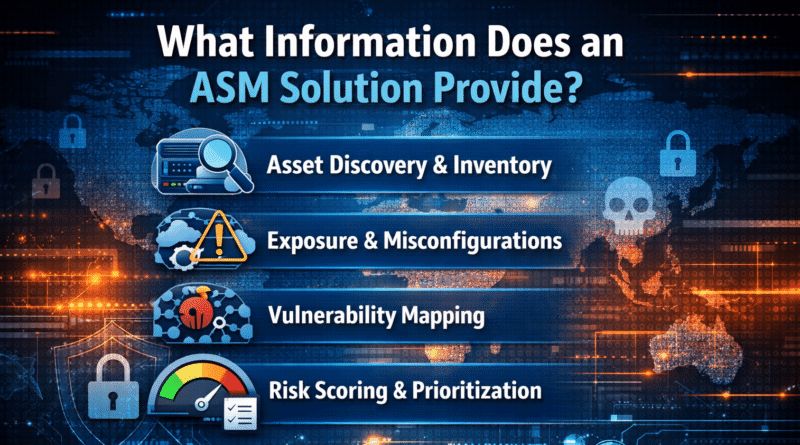
What Information Does an ASM Solution Provide?
An Attack Surface Management solution gives a comprehensive and continuously updated view of your organization’s digital footprint.
1️⃣ Asset Discovery & Inventory
- Unknown or unmanaged internet-facing assets
- Shadow IT services
- Forgotten test or staging servers
- Expired domains still resolving
2️⃣ Exposure & Misconfiguration Detection
- Open ports and services
- Misconfigured cloud storage (e.g., public S3 buckets)
- Exposed admin panels
- Weak SSL/TLS configurations
3️⃣ Vulnerability Mapping
- CVE-based vulnerabilities
- Outdated software versions
- End-of-life technologies
- Known exploit exposures
4️⃣ Risk Scoring & Prioritization
ASM tools categorize risks based on:
- Severity (Critical / High / Medium / Low)
- Exploit availability
- Asset criticality
- Business impact
5️⃣ Dark Web & Threat Intelligence Monitoring
- Leaked credentials
- Compromised domains
- Brand impersonation
- Phishing domains
What Kind of Gaps & Cybersecurity Risks Does ASM Identify?
Attack Surface Management detects risks at multiple layers:
🔴 Network-Level Risks
- Open RDP/SSH ports exposed to the internet
- Unpatched firewalls
- Legacy VPN services
🟠 Application-Level Risks
- Web application vulnerabilities
- Unsecured APIs
- Outdated CMS platforms
🟡 Cloud-Level Risks
- Public cloud storage misconfigurations
- Unrestricted access policies
- Over-permissioned IAM roles
🔵 Identity & Access Risks
- Credential leaks
- Exposed admin interfaces
- Weak authentication mechanisms
🟣 Third-Party & Supply Chain Risks
- Vendor-related exposures
- Partner domain vulnerabilities
ASM gives continuous visibility at strategic, tactical, and operational levels, making it valuable for SOC teams, CISOs, and IT administrators.
How Is ASM Different from a Vulnerability Assessment (VA) Tool?
Many organizations confuse ASM with traditional VA scanners. However, they serve different purposes.
| Feature | ASM Solution | VA Tool |
|---|---|---|
| Asset Discovery | Continuous & automatic | Limited to predefined scope |
| Unknown Assets | Detects shadow IT | Usually misses unknown assets |
| Monitoring | Continuous | Periodic scans |
| External View | Attacker’s perspective | Internal scan perspective |
| Risk Context | Business risk prioritization | Technical vulnerability listing |
| Scope | Entire digital footprint | Specific IPs or systems |
Key Difference:
- VA tool = Scans known systems for vulnerabilities.
- ASM solution = Finds unknown systems AND monitors exposure continuously.
Both are important — but ASM provides broader visibility.
Top OEMs for Attack Surface Management Solutions
Several leading cybersecurity vendors provide ASM platforms:
- Palo Alto Networks (Cortex Xpanse)
- Microsoft (Microsoft Defender External Attack Surface Management)
- UpGuard
- Tenable (Tenable ASM)
- Rapid7 (InsightVM + ASM capabilities)
- CyCognito
These OEMs provide enterprise-grade visibility and risk intelligence capabilities.
Why Is ASM Important for Organizations?
1️⃣ Expanding Digital Footprint
With hybrid cloud and remote work, organizations lose visibility over exposed assets.
2️⃣ Rising Cyber Threats
Ransomware groups scan the internet for exposed systems before launching attacks.
3️⃣ Compliance Requirements
Regulations like ISO 27001, PCI-DSS, and GDPR require continuous monitoring of exposed assets.
4️⃣ Reduced Breach Probability
Early detection of misconfigurations prevents large-scale cyber incidents.
5️⃣ Executive-Level Visibility
ASM provides risk dashboards for CISOs and management teams. Attack Surface Management plays an important role in modern enterprise security strategies. It is often included as part of a broader Cybersecurity Roadmap for Enterprises.
Real-World Example
Many major breaches happened because:
- A forgotten subdomain was exposed
- An outdated VPN was accessible
- Cloud storage was misconfigured
An effective ASM solution could have identified these exposures early.
Final Thoughts
Attack Surface Management is no longer optional — it is essential in 2026.
Organizations that rely only on traditional vulnerability scans risk missing shadow IT, unknown assets, and real-world attacker exposures.
ASM provides:
✔ Continuous asset discovery
✔ Real-time risk visibility
✔ External attacker perspective
✔ Executive risk reporting
✔ Reduced cyber attack probability
If your organization wants proactive cybersecurity posture management, implementing an ASM solution is a strategic necessity.
🔎 Recommended Reading
- Cybersecurity Roadmap for Enterprises: Complete Security Strategy Guide
- Data Encryption Explained: Why It Matters Most
- Zero Trust Network Security (ZTNA): Architecture, Use Cases & VPN Replacement Explained
- Best Password Manager: Is It Safe to Store Sensitive Passwords?
- Top 5 Cyber Threats Every Enterprise Must Prepare for in 2026